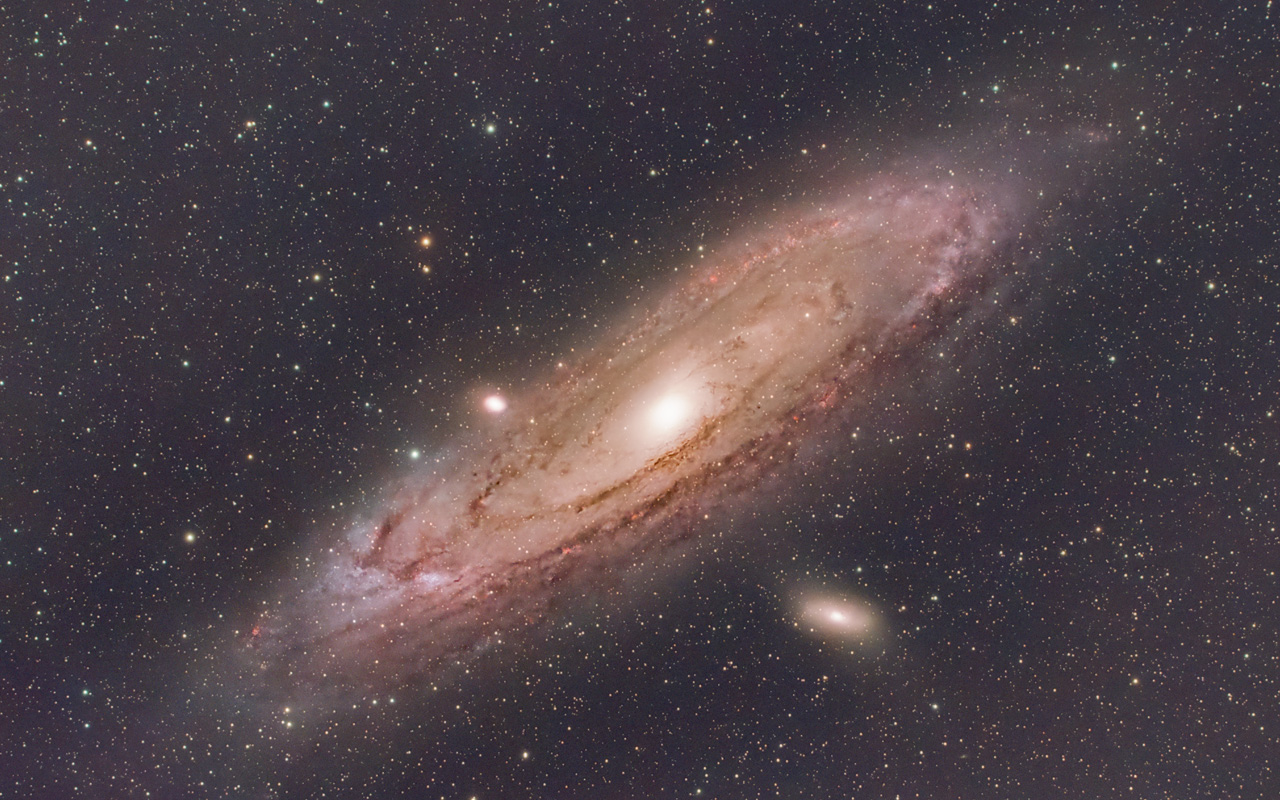
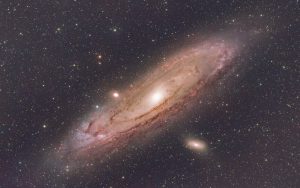
This image was captured by Steven Sze, Starhunter Astrophotographer, under the dark skies of Kuala Kubu Bharu, Selangor. Using an Askar 400, iOptron CEM25P mount, and ZWO ASI294MC Pro, he collected a total of 3 hours of exposure data to reveal the faint details and beauty of this celestial object.





Starhunter Astrophotographer — Steven Sze
Messier 31 The Andromeda Galaxy
Object Type: Barred Spiral Galaxy
What you are seeing is not a nebula, and not a cloud within our Milky Way.This is the Andromeda Galaxy — Messier 31, or M31 — a vast barred spiral galaxy and the nearest major galaxy to our own Milky Way.It is located approximately 2.5 million light-years from Earth. When you look at Andromeda, you are looking across 2.5 million years of space and time.
Historical identity – Andromeda Nebula.
Andromeda is also known as NGC 224.Before astronomers understood that galaxies existed beyond the Milky Way, this object was called the Andromeda Nebula.Today, we know that it is an enormous independent galaxy containing an estimated one trillion stars — potentially around twice the estimated number of stars in our own Milky Way.And remarkably, under sufficiently dark skies, M31 can be seen with the naked eye.It is one of the brightest and most accessible objects in the Messier catalogue.
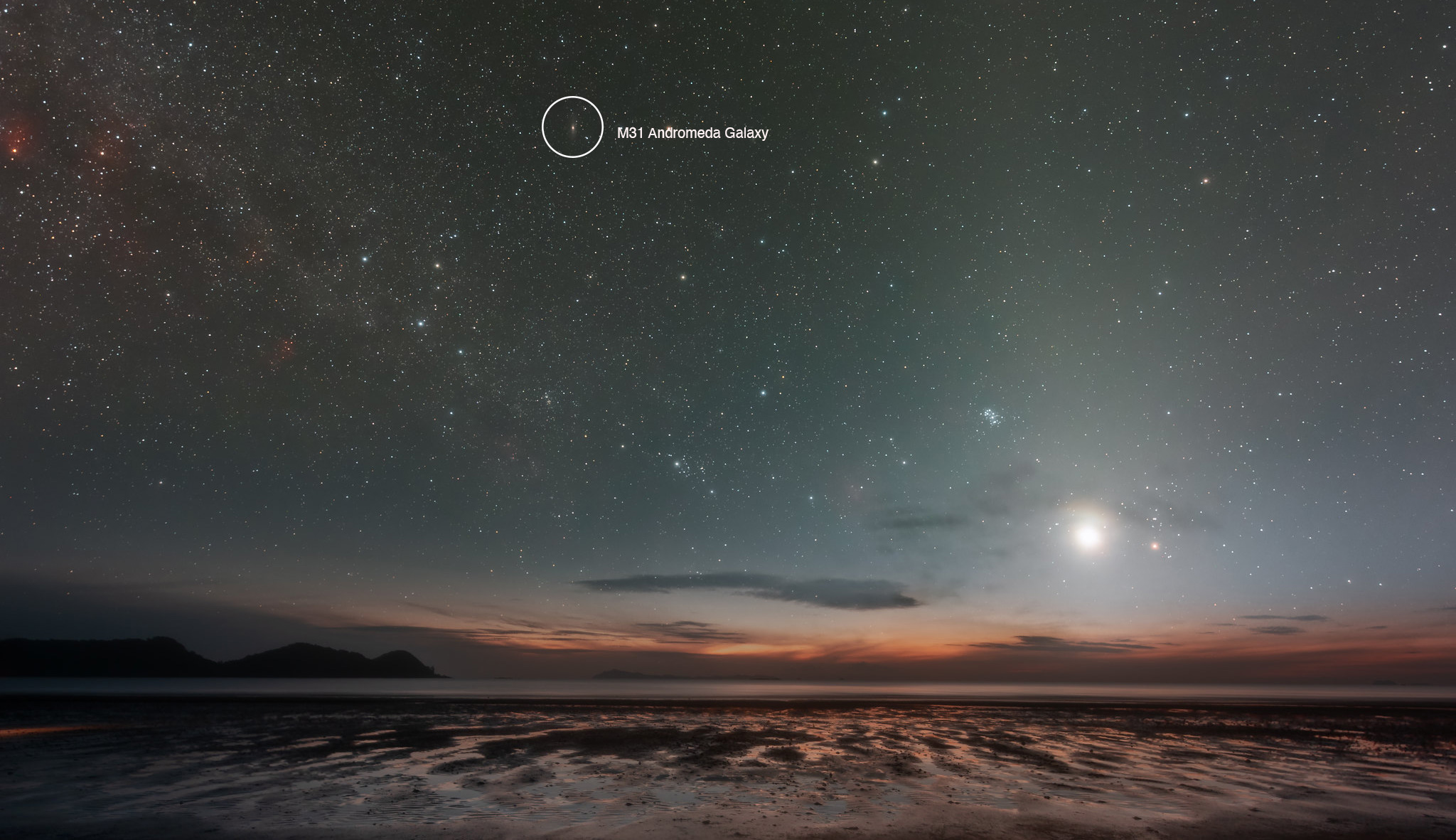
How to Locate M31 in the Night Sky?
Finding Andromeda in the night sky is relatively easy.
M31 lies within the constellation Andromeda, close to two familiar landmarks in the northern sky.One is the Great Square of Pegasus, formed by the bright stars Alpheratz, Algenib, Markab and Scheat. The other is Cassiopeia, with its distinctive W-shaped asterism.From these familiar patterns, observers can navigate toward the Andromeda Galaxy.
And once you know where to look, that faint, elongated glow becomes one of the most rewarding sights in the night sky.
Galaxy Structure
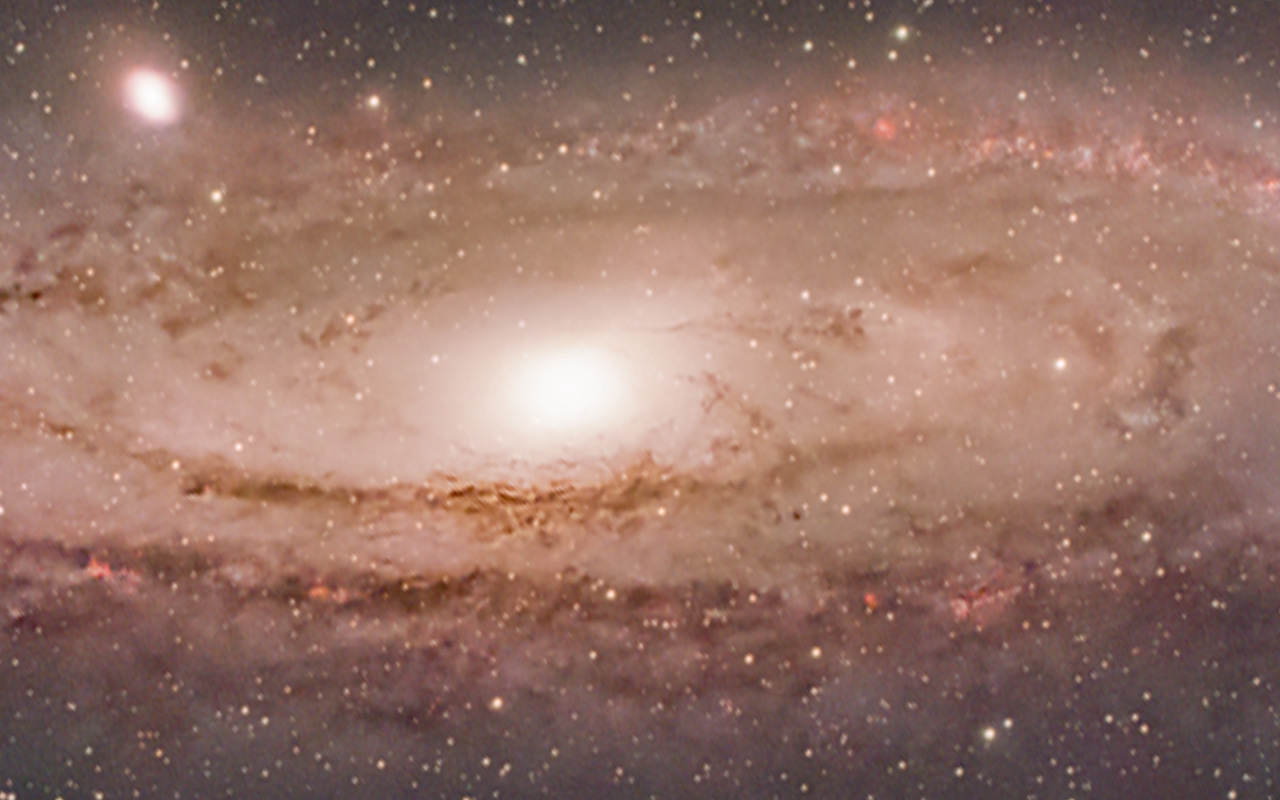
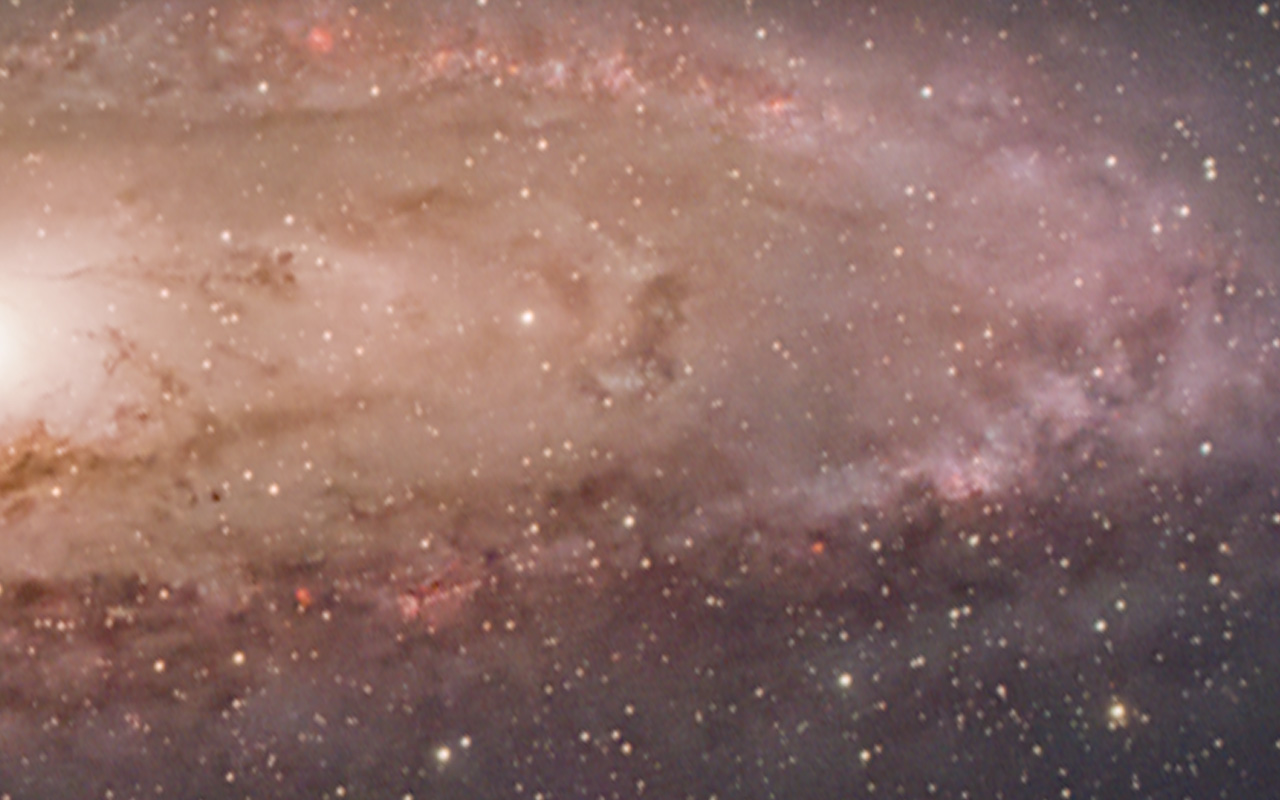
But this image reveals far more than a glowing oval.Andromeda is a barred spiral galaxy, with a central structure surrounded by enormous spiral arms.Within those arms are vast clouds of gas and dust where new stars are continuously forming.
Among them are H II regions — glowing clouds of ionised hydrogen.
These regions mark areas of recent and massive star formation, where young, energetic stars are exciting the surrounding hydrogen gas.The faint red structures visible across the galaxy are therefore not simply colour.They are signatures of stellar nurseries scattered throughout Andromeda’s spiral arms.
Andromeda has an incredibly ancient history.The galaxy is estimated to be around 5 to 10 billion years old, while some of its oldest stars and halo populations date back as far as 13 billion years.Its present-day spiral structure was not created all at once. Over billions of years, smaller galaxies merged with Andromeda, helping shape the large spiral galaxy we see today.So when we photograph M31, we are not simply seeing a galaxy.We are seeing the result of billions of years of cosmic evolution.
Astrophotography
Capturing the Andromeda Galaxy requires careful planning and precise astrophotography techniques.Although M31 is bright enough to be seen with the naked eye under dark skies, its faint outer regions, delicate dust lanes, and subtle structures require long exposures, accurate tracking, and multiple image frames.By combining and stacking these exposures, astrophotographers can collect far more light than a single exposure could capture, revealing details that are invisible to the human eye.
Through careful image processing, the final photograph brings out Andromeda’s majestic spiral structure, intricate dust lanes, star-forming regions, and immense scale — transforming faint photons from a galaxy 2.5 million light-years away into a detailed portrait of our cosmic neighbour.
The Andromeda Galaxy is our closest major galactic neighbour.
It contains perhaps one trillion stars, spans an enormous region of space, and carries a history stretching back billions of years.
Yet tonight, we can look toward a small patch of sky and see it with our own eyes.
A galaxy 2.5 million light-years away.
A trillion stars.
Billions of years of cosmic history.
And through astrophotography, we capture that ancient light —
one photon at a time.
Starhunter — Capturing the Invisible Universe.
Object Fact Sheet — Messier 31 Andromeda Galaxy
Common Name: Andromeda Galaxy
Object Type: Barred Spiral Galaxy
Cataloged: Messier 31 (M31), NGC 224
Other Names: Andromeda Nebula
Constellation: Andromeda
RA (Right Ascension): 00h 42m 44.3s
DEC (Declination): +41° 16′ 09″
Age: About 5–10 billion years
Distance: About 2.5 million light-years
Apparent Magnitude: 3.44
Angular Size: About 3° × 1°