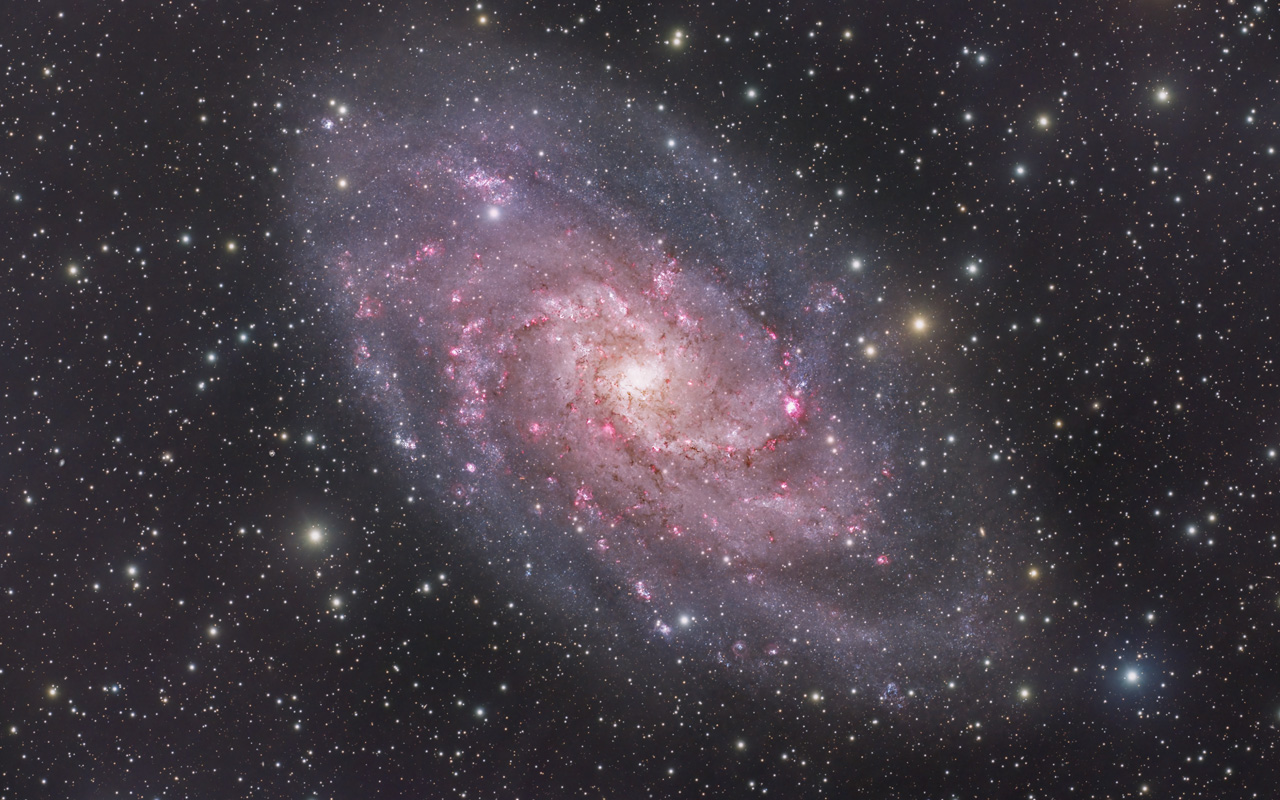
This image of the M33 Triangulum Galaxy and its prominent H II regions was captured by Stanley Tang Chee Sun, Starhunter Astrophotographer, under the exceptionally dark skies of the Xinjiang Starhunter RemoteClearSky Observatory.Using an Askar 600 telescope, ZWO AM5N mount, and ZWO ASI6200MM camera, Stanley collected a total of 1.5 hours of imaging data. A specialized Antlia LRGB + Hα + O III filter combination was used to enhance the galaxy’s intricate structure and bring out the faint red glow of its active H II regions.




Podcast English
Podcast 中文

Starhunter Astrophotographer — Stanley Tang
The additional Hα and O III data reveal areas of ionized gas associated with ongoing star formation, highlighting the contrast between M33’s delicate spiral structure and its vibrant stellar nurseries.Despite the relatively short integration time, the image captures the fine details and complex structure of M33, offering a deeper view of one of our Local Group’s nearest spiral galaxies.
Messier 33 — The Triangulum Galaxy
Object Type: Spiral Galaxy
What you are seeing is Messier 33, M33 — the Triangulum Galaxy, a beautiful spiral galaxy located about 3 million light-years from Earth in the constellation Triangulum.At roughly half the size of our Milky Way, M33 is the third-largest galaxy in the Local Group, after the Andromeda Galaxy and the Milky Way.But despite its smaller size, M33 is an extraordinarily active galaxy.
Galaxy Structure
Unlike the massive Andromeda Galaxy, M33 has a relatively orderly spiral structure, with loosely wound arms extending from its central region. There are few obvious signs of major interactions with nearby galaxies.
But this peaceful appearance may not last forever. M33 is a suspected gravitational companion of Andromeda, and both galaxies are moving through space toward our own region of the Local Group.
In the distant future, M33 could become involved in the dramatic interaction between Andromeda and the Milky Way, expected to unfold more than 4 billion years from now.
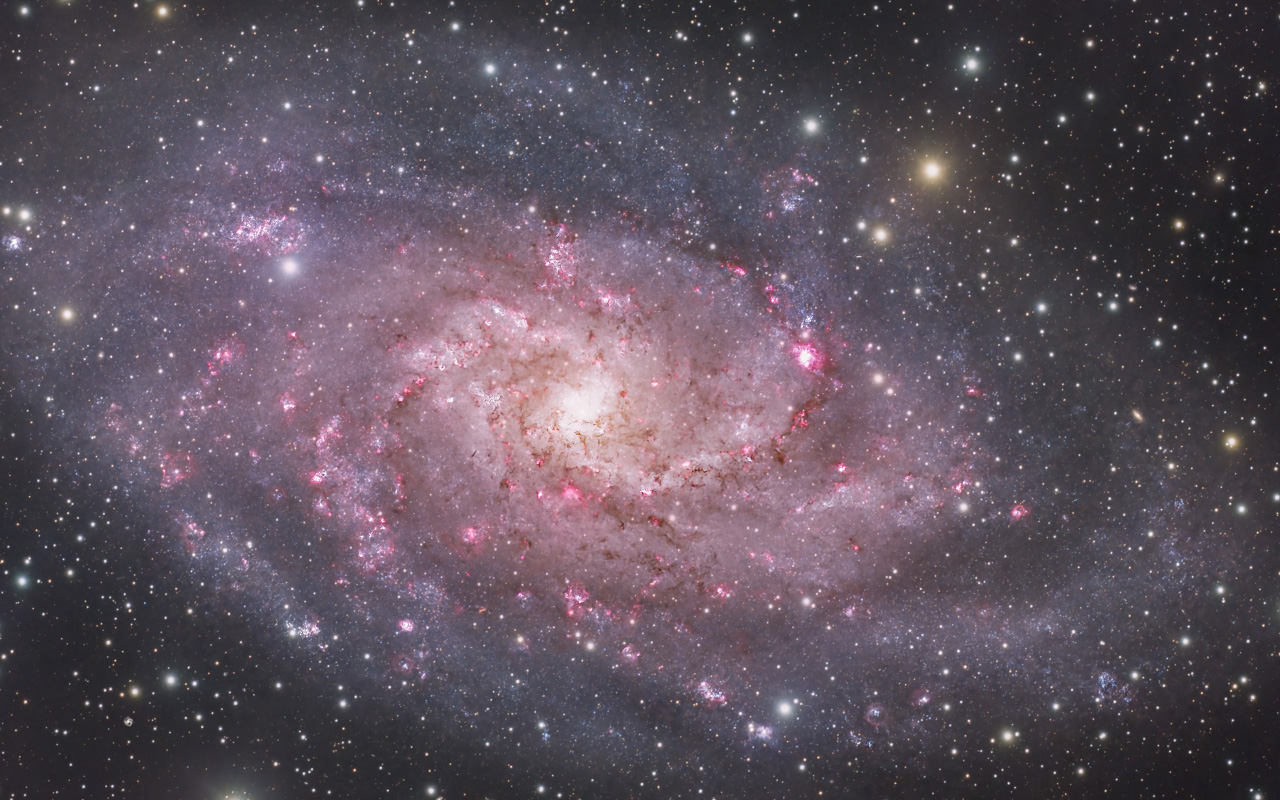
Star Formation — Blue Regions
One of the most remarkable features of M33 is its intense star formation.
The blue regions scattered throughout the galaxy reveal numerous areas where massive young stars are being born.
Hubble observations show that M33’s star formation rate is roughly ten times higher than the average rate measured in Andromeda.These stellar nurseries are spread throughout the galaxy’s loosely wound spiral arms.
And hidden within them are enormous clouds of ionised hydrogen known as H II regions.
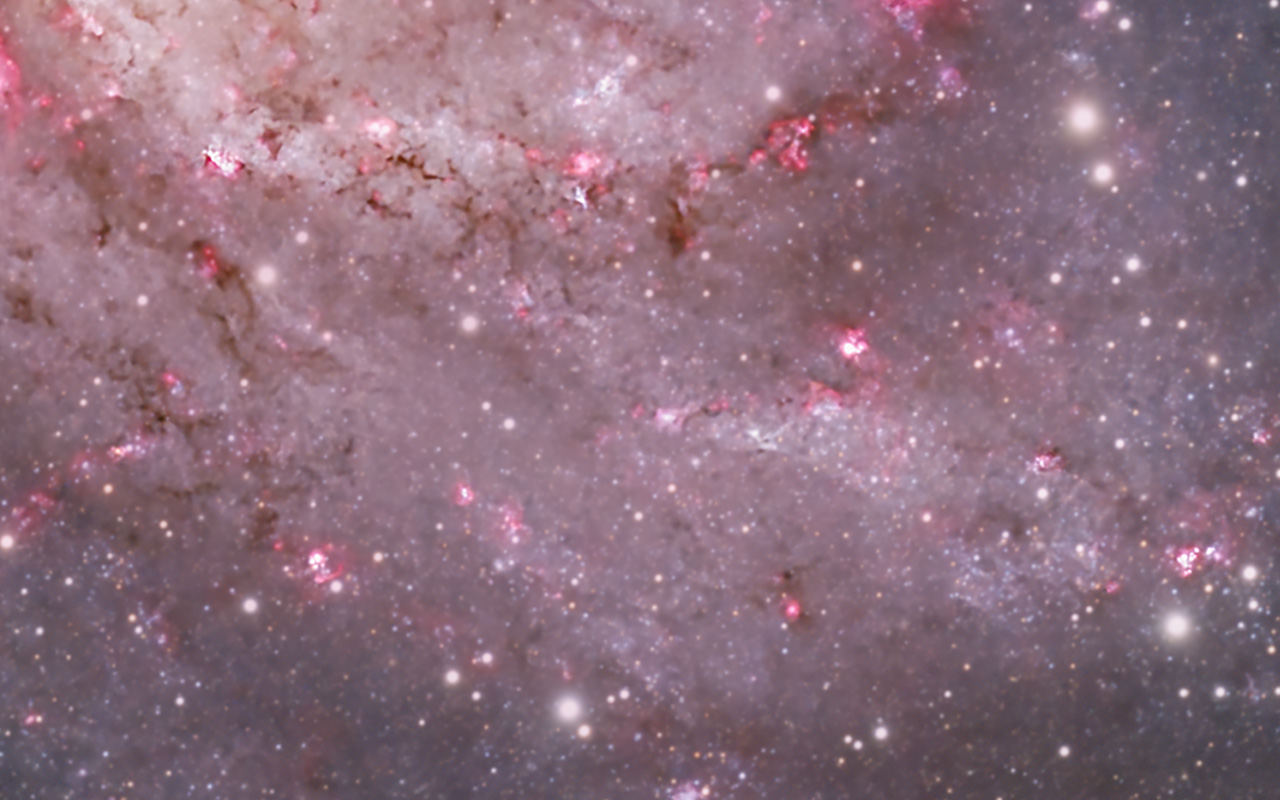
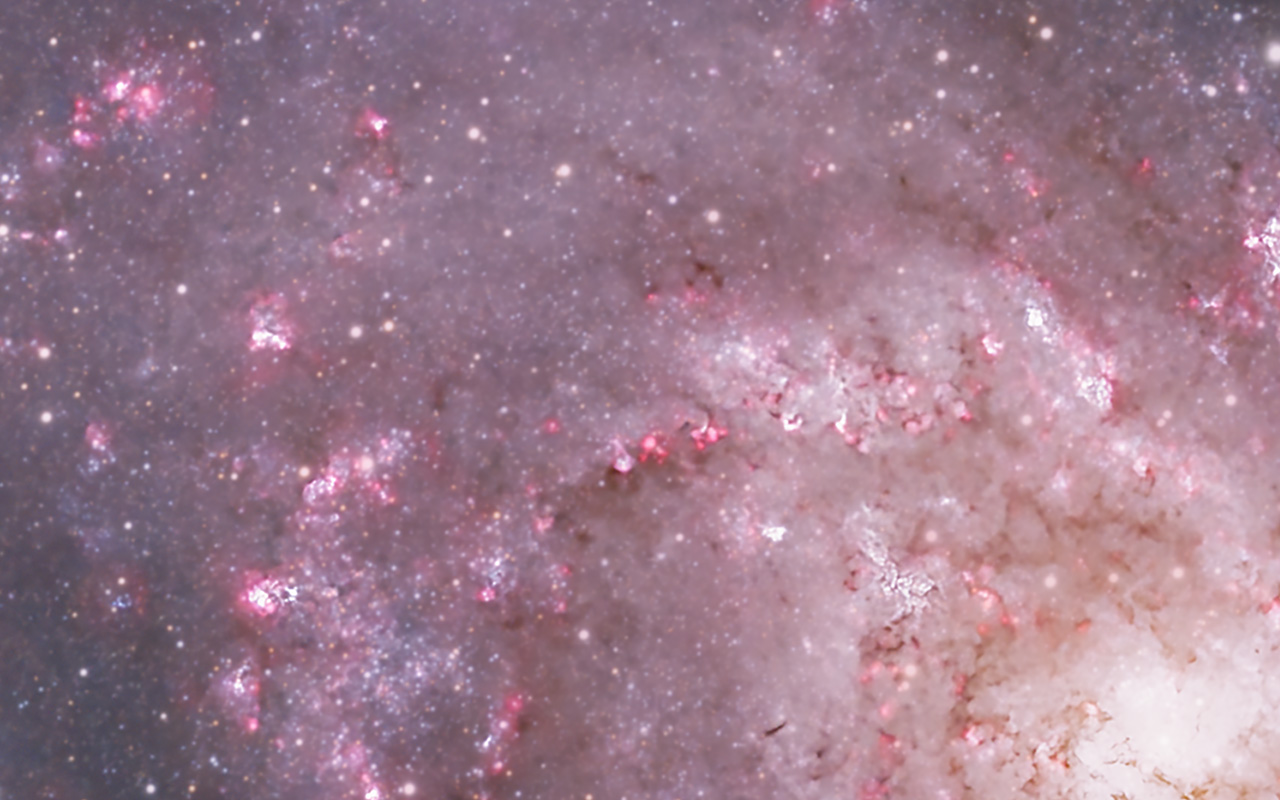
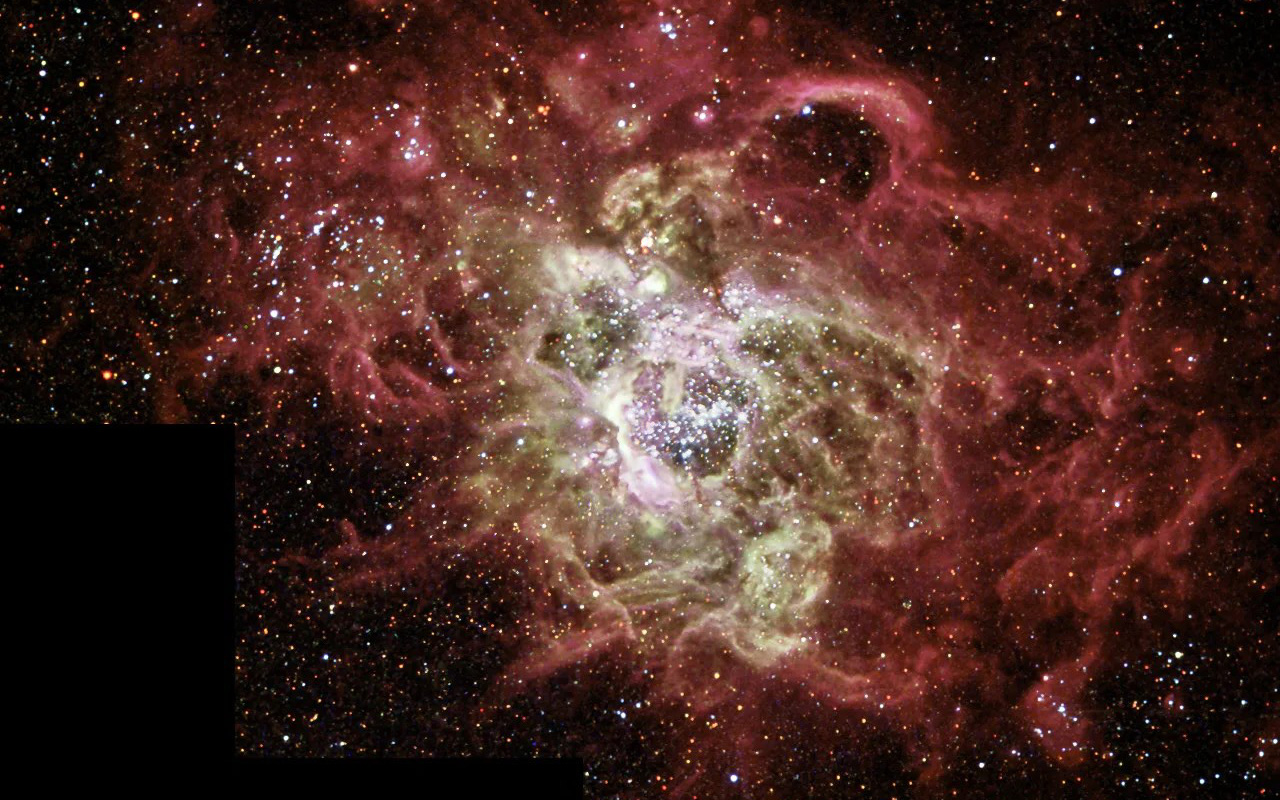
One region stands out above all the others.
This is NGC 604, located toward the lower-left region of the galaxy.NGC 604 is the largest and most luminous star-forming region in M33, and one of the largest stellar nurseries in the entire Local Group.It spans roughly 1,500 light-years — around 40 times larger than the Orion Nebula.Inside NGC 604, massive young stars release intense ultraviolet radiation.This radiation strips electrons from surrounding hydrogen atoms, creating ionised gas that glows brightly — producing the characteristic hydrogen-alpha red emission seen in astrophoto.
H II regions — NGC 595, 588 & 592
NGC 604 is not alone.M33 contains many other spectacular H II regions.NGC 595 is a prominent diffuse emission nebula energized by hot, young stellar clusters. NGC 588 and NGC 592 are smaller but distinct clouds of ionised hydrogen embedded along the galaxy’s spiral arms.Together, these regions reveal a galaxy where new stars are continually transforming the surrounding gas and dust.
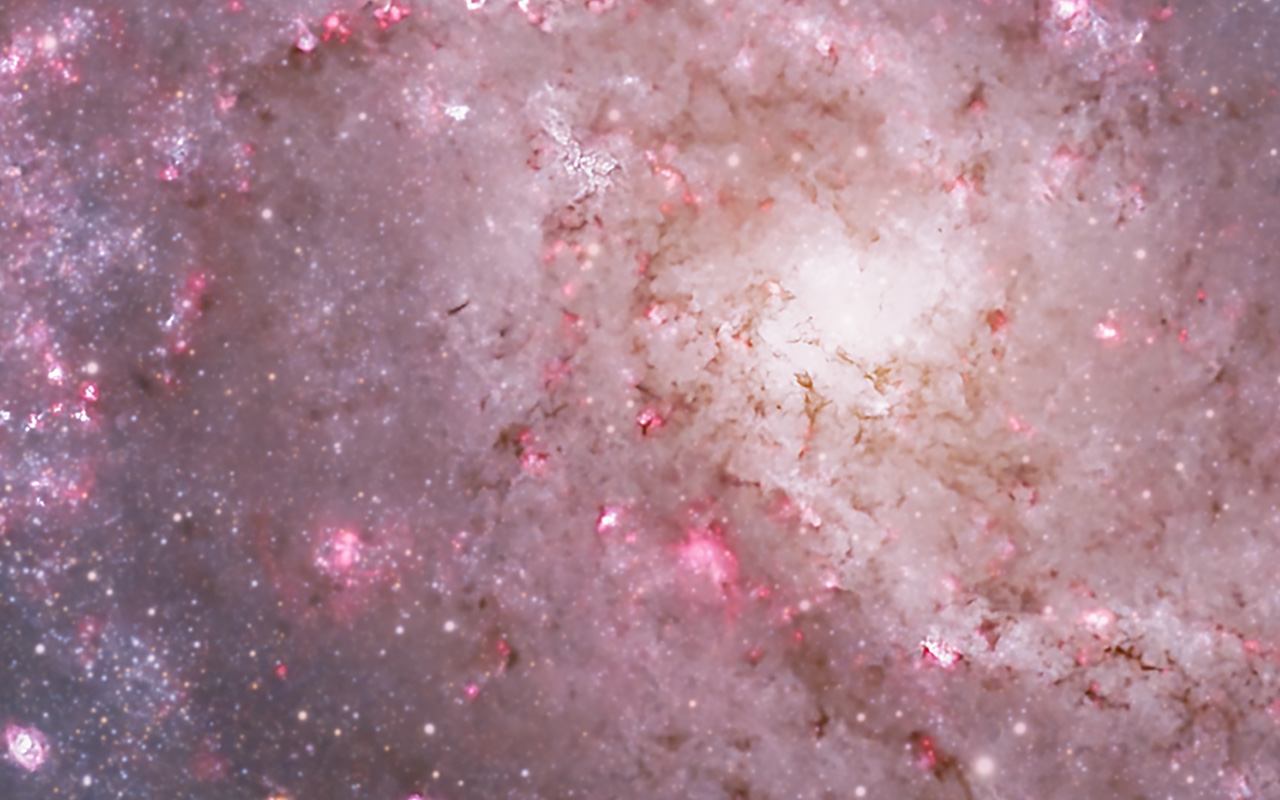
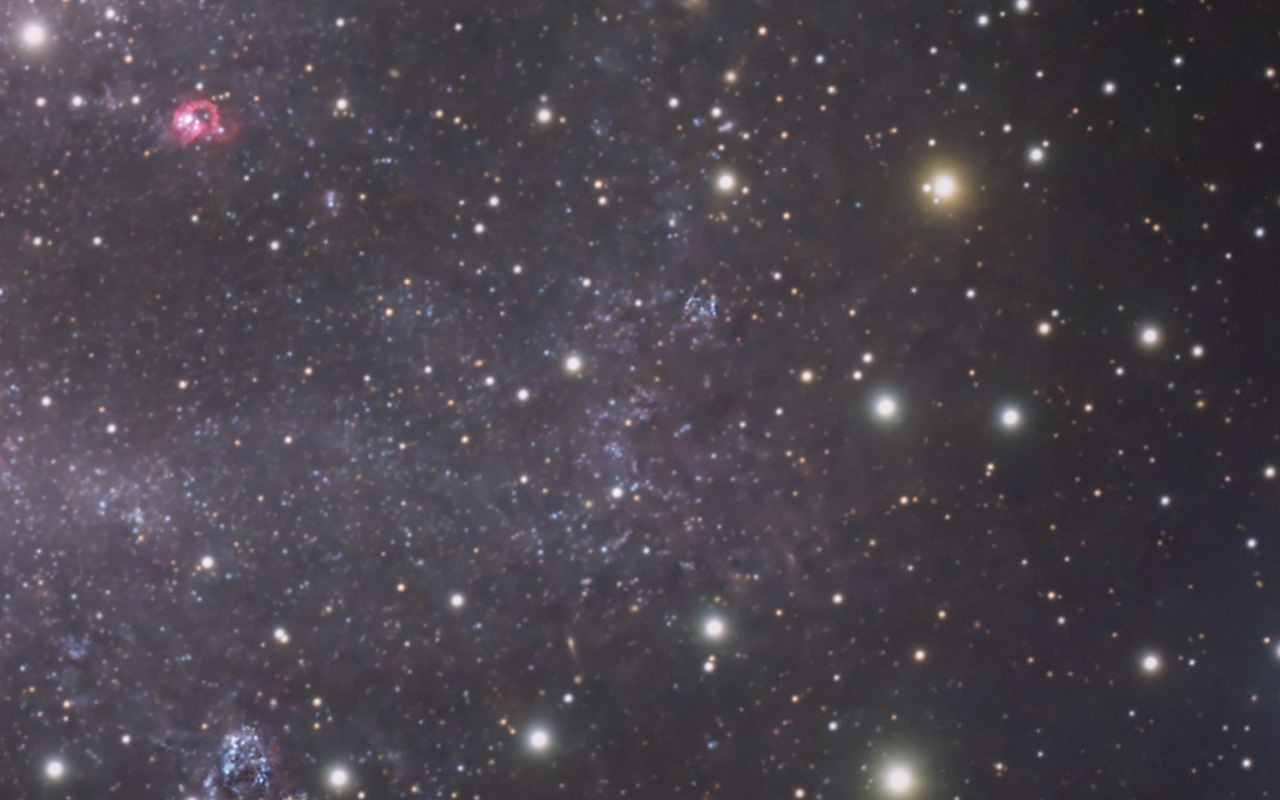
These faint structures can be challenging to capture.The diffuse light of M33 is spread across a large area of sky, making its delicate spiral structure and star-forming regions relatively low in contrast.Astrophotographers can combine broadband exposures with narrowband hydrogen-alpha data to bring out the faint red emission from the H II regions.With careful tracking, long exposures, stacking and processing, details invisible to the human eye begin to emerge.The result is a portrait not only of a galaxy, but of millions of individual stars and enormous stellar nurseries.
M33 has an apparent magnitude of around 5.7.Under exceptionally clear and dark skies, it can be seen with the unaided eye, making it one of the most distant objects visible to human vision.Interestingly, M33 is often easier to observe with binoculars or a low-power, wide-field telescope than with high magnification.And when we photograph it, we reveal something even more extraordinary:
a galaxy roughly half the size of the Milky Way, filled with active stellar nurseries and millions of newborn stars.
Three million light-years away, M33 is quietly creating its next generation of stars.
Another galaxy.
Another stellar nursery.
Another chapter in the story of the universe.
Starhunter — Capturing the Invisible Universe.
Object Fact Sheet — Messier 33 — The Triangulum Galaxy
ommon Name: Triangulum Galaxy
Object Type: Spiral Galaxy
Cataloged: Messier 33 (M33), NGC 598
Other Names: Triangulum Galaxy
Constellation: Triangulum
RA (Right Ascension): 01h 33m 50.9s
DEC (Declination): +30° 39′ 37″
Age: About 10 billion years
Distance: About 2.7–3.0 million light-years
Apparent Magnitude: 5.7
Angular Size: About 73.0′ × 45.7′