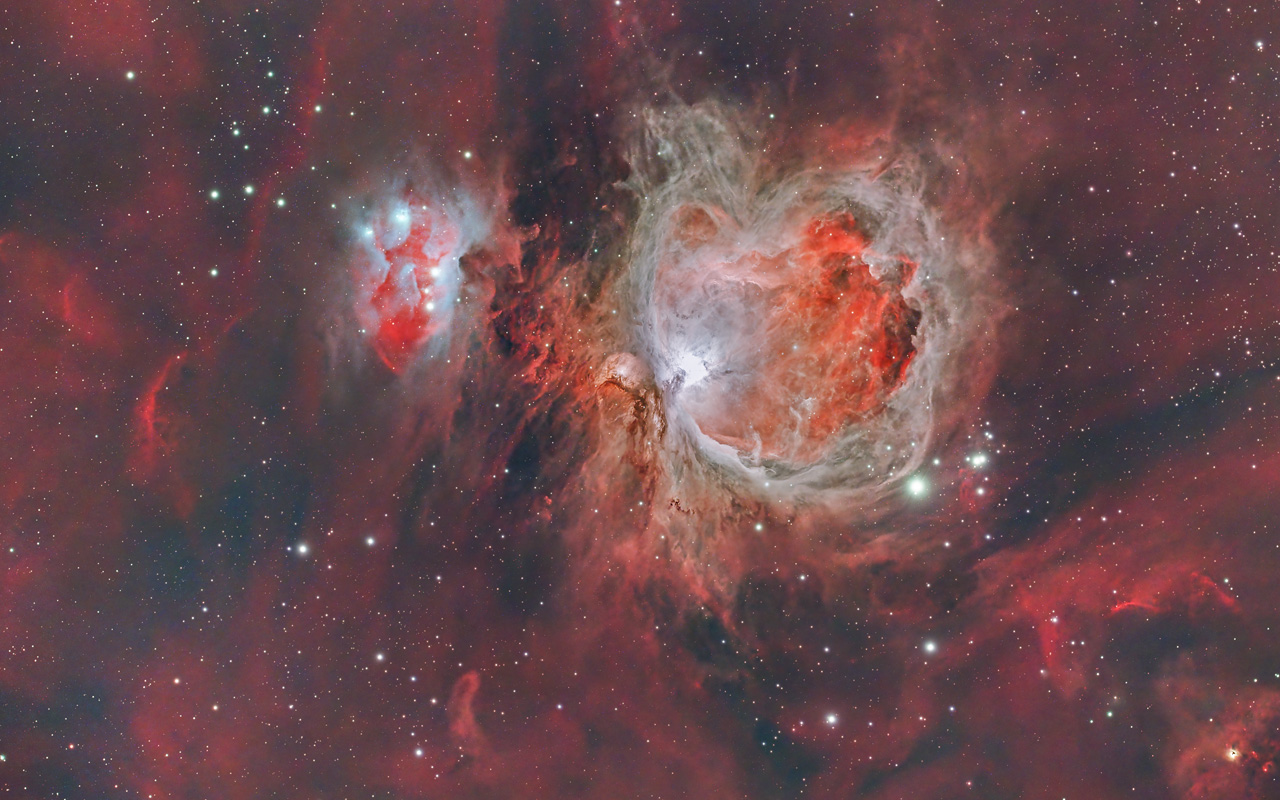
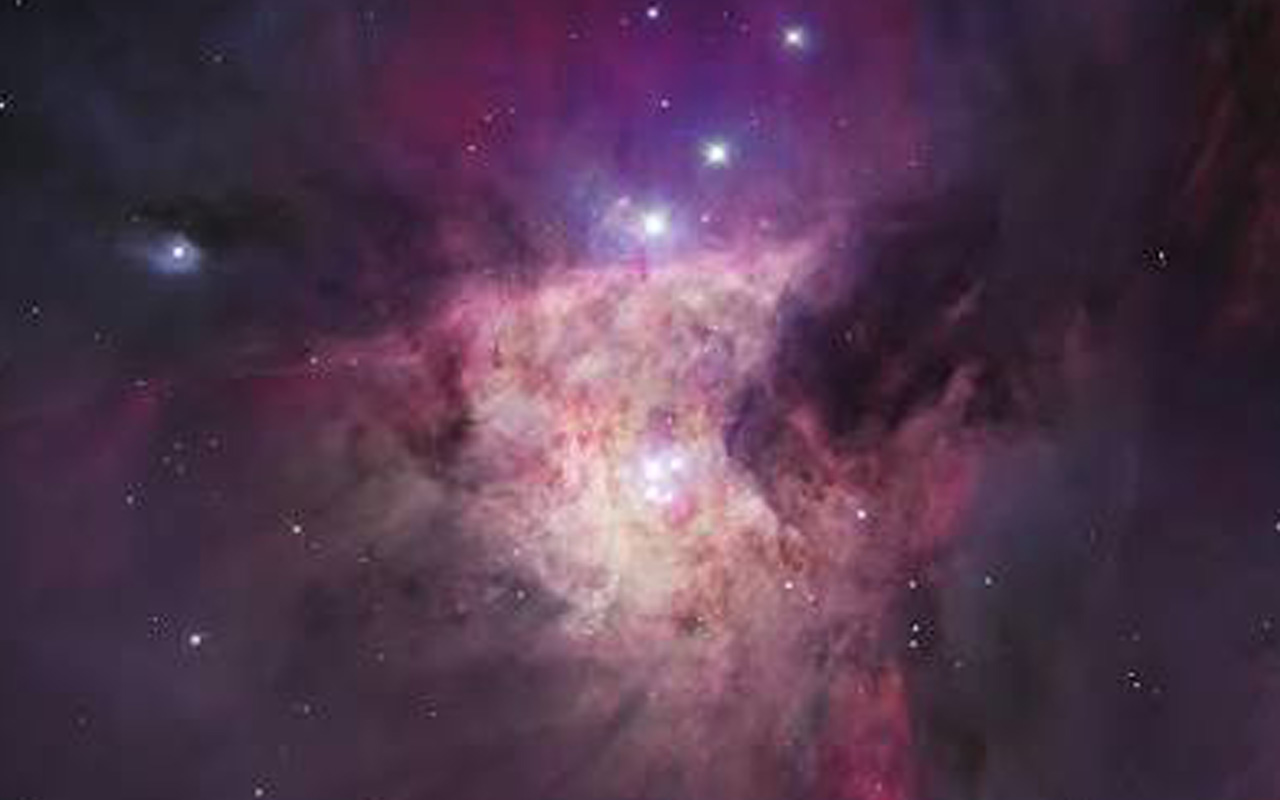
This image of the M42 Orion Nebula was captured by Sam Kok, Starhunter Astrophotographer, under the dark skies of Koref Leisure Farm, Johor.Using an Askar 500, ZWO AM3 mount, and ZWO ASI2600MC Pro, Sam collected a total of 4.5 hours of exposure data.




Starhunter Astrophotographer — Sam Kok
A specialized Ultimate Dual-Band Filter was used to isolate and enhance the nebula’s emission regions, revealing subtle structures and intricate details within the cloud of glowing gas and dust.The result brings out the rich complexity of M42, transforming this familiar winter landmark into a detailed portrait of one of the most spectacular stellar nurseries in the night sky.
Messier 42 The Orion Nebula
Object Type: Diffuse Nebula / H II Region / Star-Forming Region
Deep in the constellation Orion, just below Orion’s Belt, lies one of the most famous and spectacular nebulae in the night sky.This is the Orion Nebula — Messier 42, or M42, also catalogued as NGC 1976. It is a vast cloud of gas and dust — and one of the closest regions of massive star formation to Earth
Naked-Eye Nebula
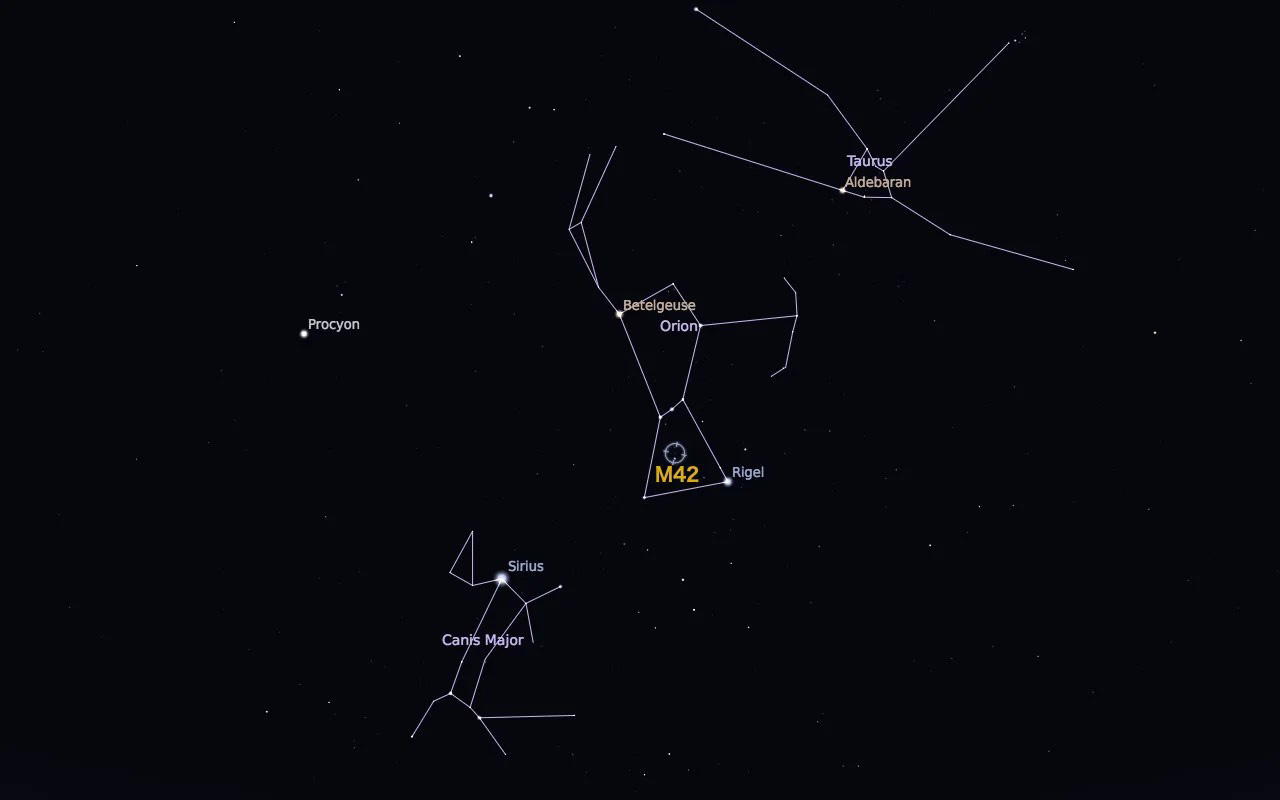
The Orion Nebula is remarkably bright.With an apparent magnitude of around 4.0, it can be seen with the naked eye under dark skies.Look toward Orion’s Belt, then follow the three stars downward to Orion’s Sword.M42 appears as the middle, slightly fuzzy “star” in the Sword.For thousands of years, different cultures have noticed this mysterious glow.
Among them were the Maya of Mesoamerica, who associated the bright region with the cosmic fire of creation.
Scale and Distance
The Orion Nebula lies roughly 1,300 light-years from Earth, making it the closest major massive star-forming region to us.It stretches approximately 25 light-years across, appearing about one degree wide in our sky.The nebula contains around 2,000 times the mass of our Sun in gas and dust.And this is only one part of something much larger.
M42 sits inside the enormous Orion Molecular Cloud Complex, which extends across hundreds of light-years and spans much of the constellation Orion.
Trapezium Cluster
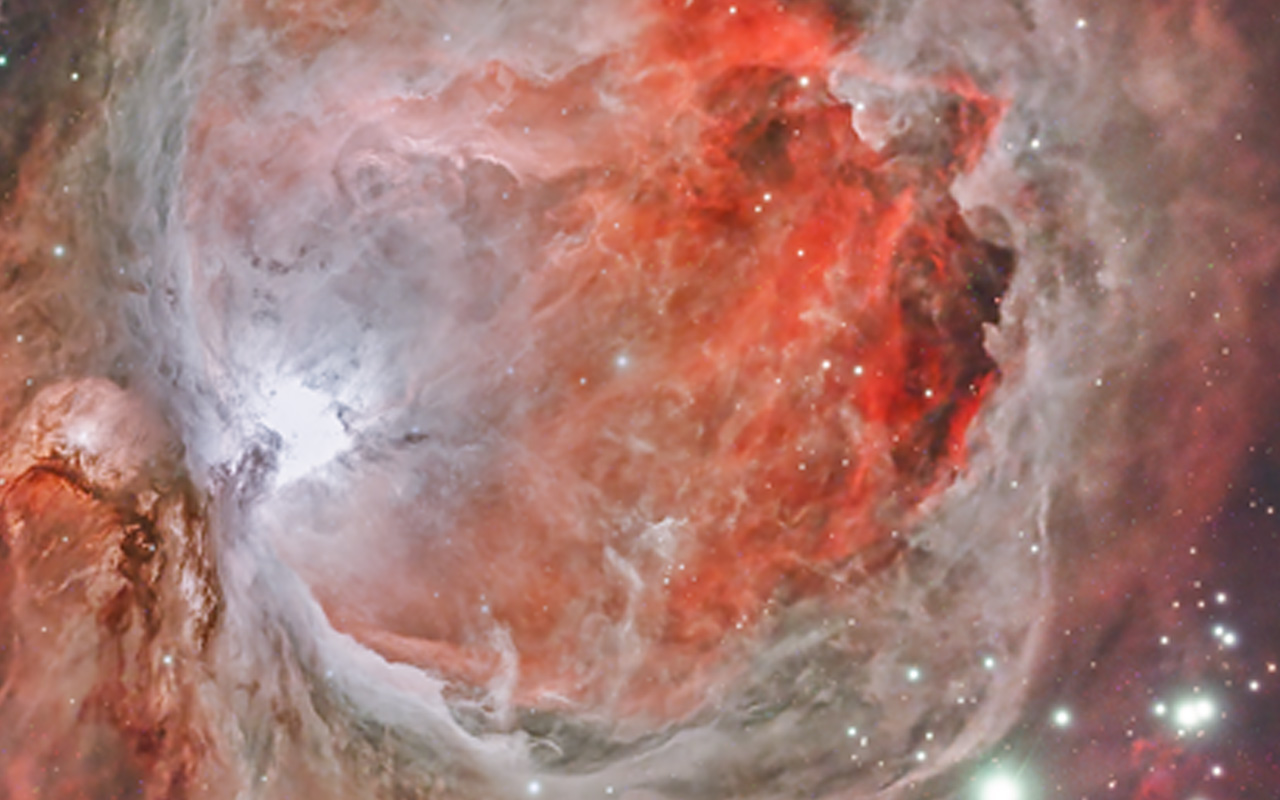
At the heart of the nebula lies a remarkably young group of stars known as the Trapezium Cluster.
Its name comes from the distinctive arrangement of its four brightest stars.Together with many other young stars, the Trapezium is part of the much larger Orion Nebula Cluster, an association containing around 2,800 stars across roughly 20 light-years.The Trapezium itself is only about 1.5 light-years across.On nights with excellent seeing, two of its brightest stars can even be resolved into binary systems, revealing a total of six stars.These stars are still in their very early stages of life.
Stellar Birth
The Orion Nebula is more than a beautiful cloud.
It is one of the best natural laboratories for studying how stars and planetary systems are born.
Astronomers have directly observed protoplanetary disks — rotating disks of material that can eventually form planets — as well as brown dwarfs within the nebula.The gas here is highly turbulent, while powerful young stars constantly shape their surroundings.The intense radiation from massive stars produces photo-ionisation, causing the surrounding gas to glow.
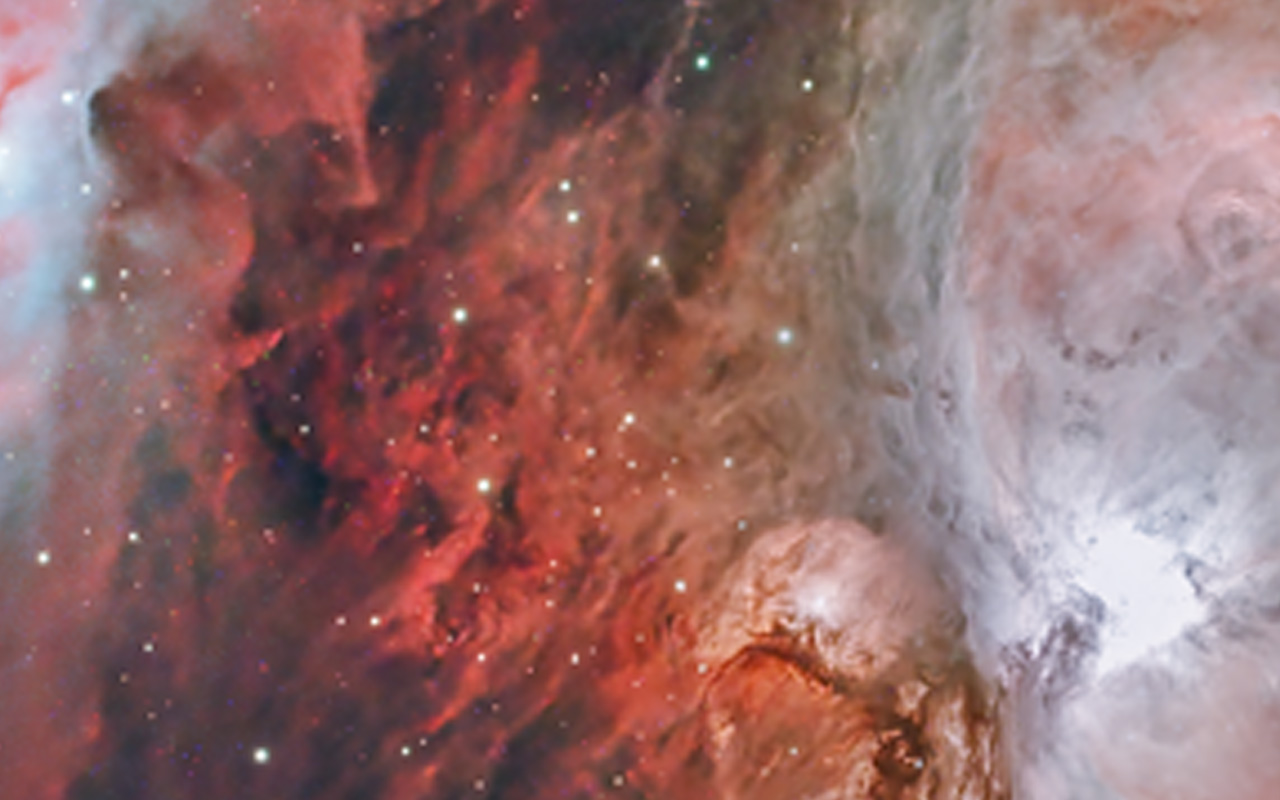
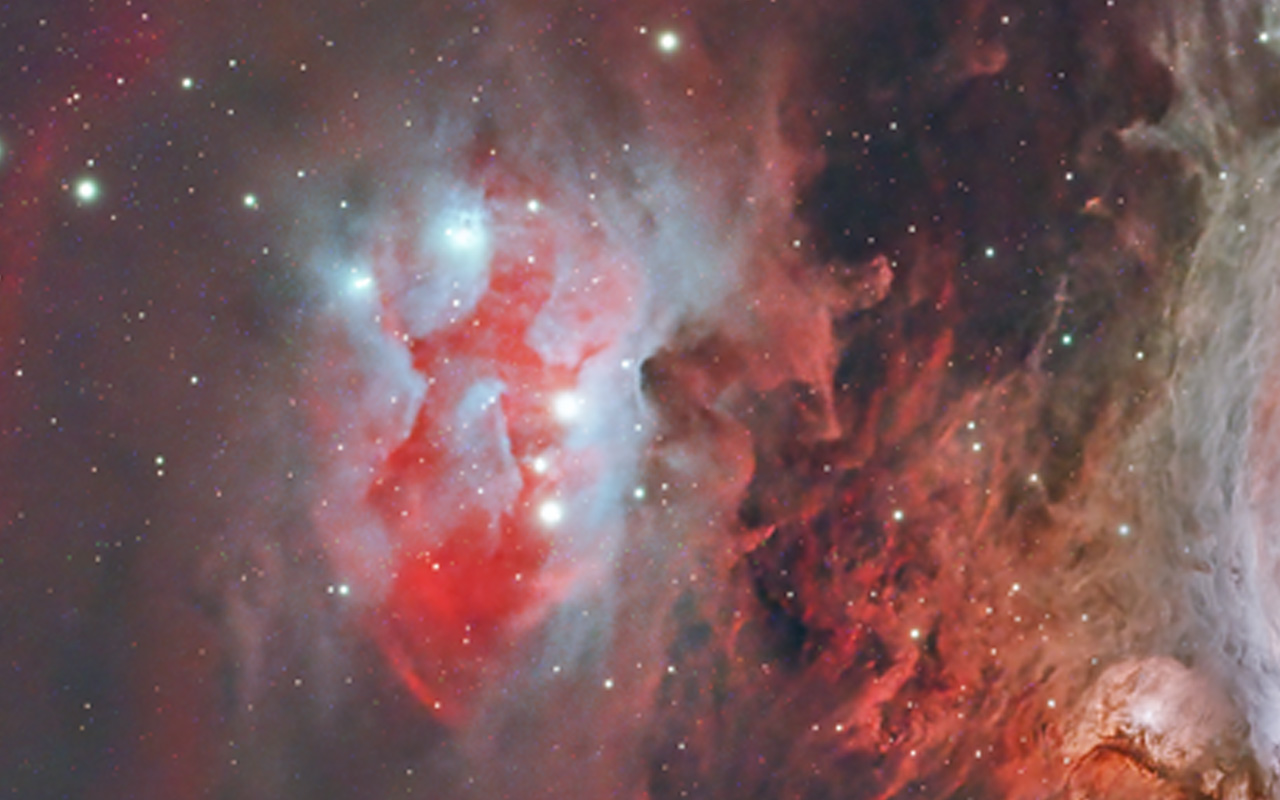
The Orion Nebula is famous for its complex colours.The distinctive red regions are strongly associated with the H-alpha emission line, produced when ionised hydrogen recombines at a wavelength of 656.3 nanometres.The blue-violet areas are largely created by starlight reflected from dust, particularly light from the massive O-type stars near the centre.
And the characteristic greenish tint long reported by observers comes from emission from highly excited oxygen and other ionised gases.Each colour is therefore telling us something about the physical conditions inside the nebula.
The Orion Nebula is a place where stars are being born right now.Within this enormous cloud, gravity gathers gas and dust together, while young massive stars illuminate and reshape their birthplace.From ancient civilizations observing its mysterious glow to modern astrophotographers capturing its hidden structures, M42 continues to reveal the story of stellar birth.
A cosmic nursery.
A laboratory of planet formation.
A birthplace of stars.
And only about 1,300 light-years away, we can see it with our own eyes.
Through astrophotography, we capture that ancient light —
one photon at a time.
Starhunter — Capturing the Invisible Universe.
Object Fact Sheet — Messier 42 The Orion Nebula
Common Name: Orion Nebula
Object Type: Diffuse Nebula / H II Region / Star-Forming Region
Cataloged: Messier 42 (M42), NGC 1976
Other Names: Great Orion Nebula, Great Nebula in Orion
Constellation: Orion
RA (Right Ascension): 05h 35m 17.3s
DEC (Declination): −05° 23′ 28″
Age: About 3 million years
Distance: About 1,300 light-years
Apparent Magnitude: 4.0
Angular Size: About 1° × 1°