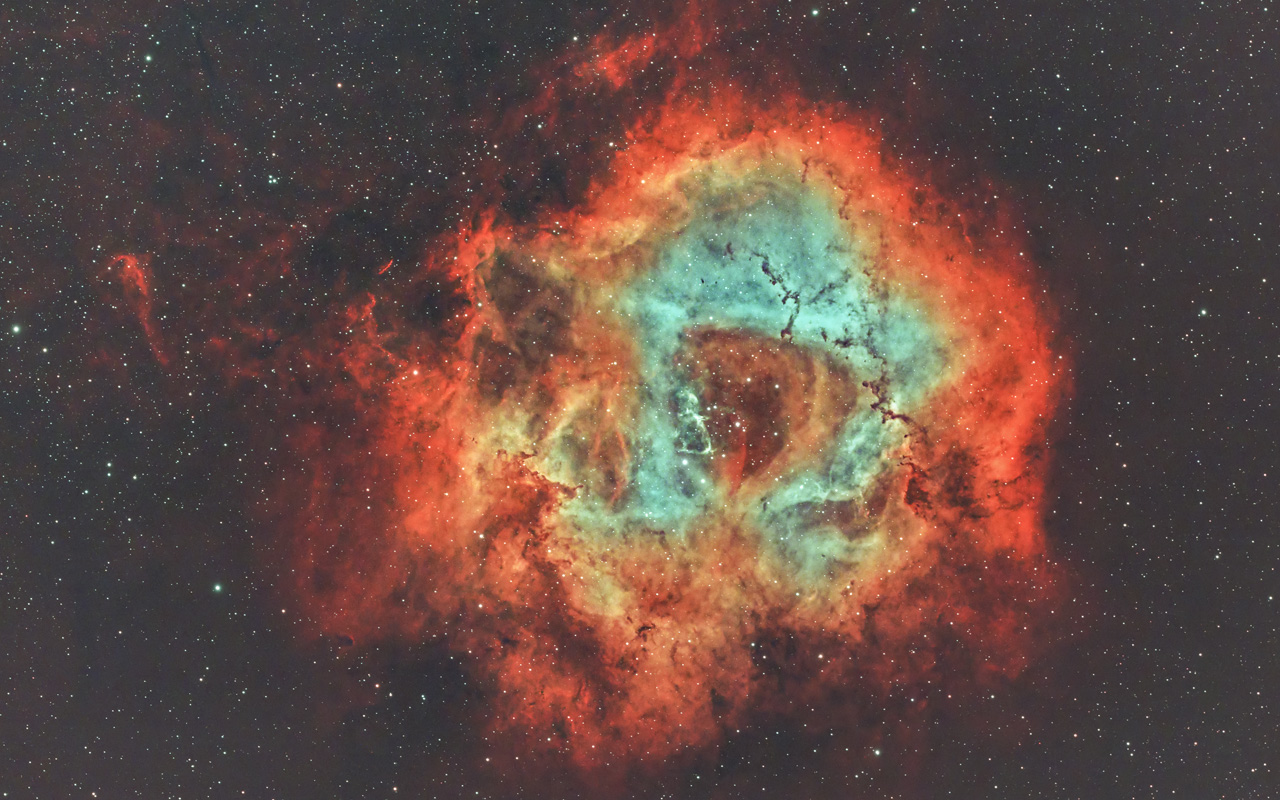
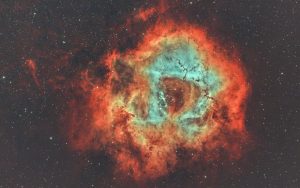
This image was captured by Wilson Chang Eng Chen , Starhunter Astrophotographer, under the dark skies of Kuala Kubu Bharu, Selangor. Using an Askar 400, ZWO AM3 mount, and ZWO ASI2600MC Pro, he collected a total of 2.5 hours of exposure data to reveal the intricate details and beauty of the Rosette Nebula.





Starhunter Astrophotographer — Wilson Chang Eng Chen
Using a specialized SHO Hubble Palette blend, Wilson brings out the different emission elements within the nebula, transforming the familiar Rosette Nebula into a striking view of its complex structure and vibrant cosmic gases.
Caldwell 49 The Rosette Nebula
Object Type: H II Region / Emission Nebula / Star-Forming Region
Look closely at this image.What appears to be a giant cosmic rose is actually a vast cloud of glowing gas and dust — the Rosette Nebula, also known as Caldwell 49.Located about 5,000 light-years from Earth in the constellation Monoceros, the Rosette is a giant H II region and an active stellar nursery.Its beautiful circular shape has also earned it another nickname — the “Skull Nebula”, although it should not be confused with NGC 246, which has the same nickname.
Scale and Structure
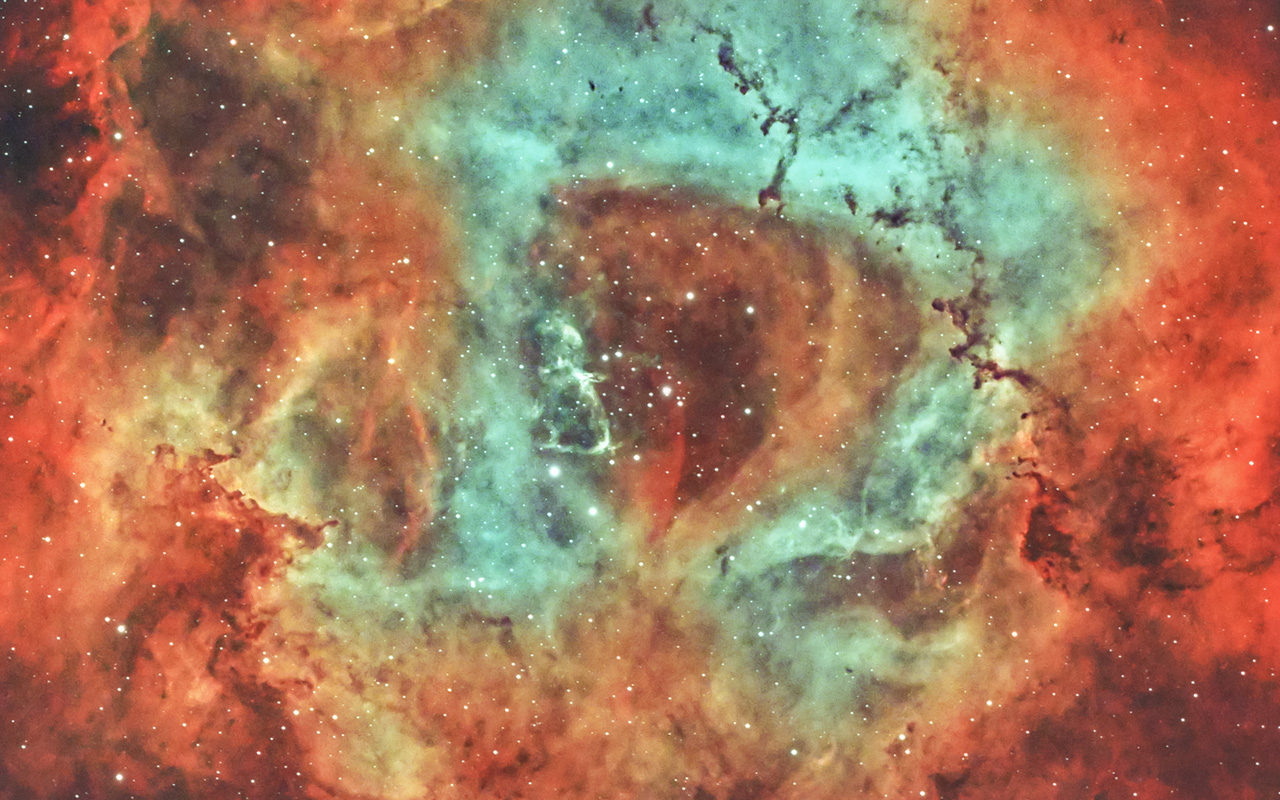
The Rosette Nebula is enormous.It stretches roughly 100 to 130 light-years across, with an estimated mass of around 10,000 times the mass of our Sun.At its centre lies the young open star cluster NGC 2244, also known as Caldwell 50.
The stars of this cluster were formed from the very material of the nebula itself.
Today, these young, hot stars are transforming their birthplace.
NGC 2244 — Central Cluster
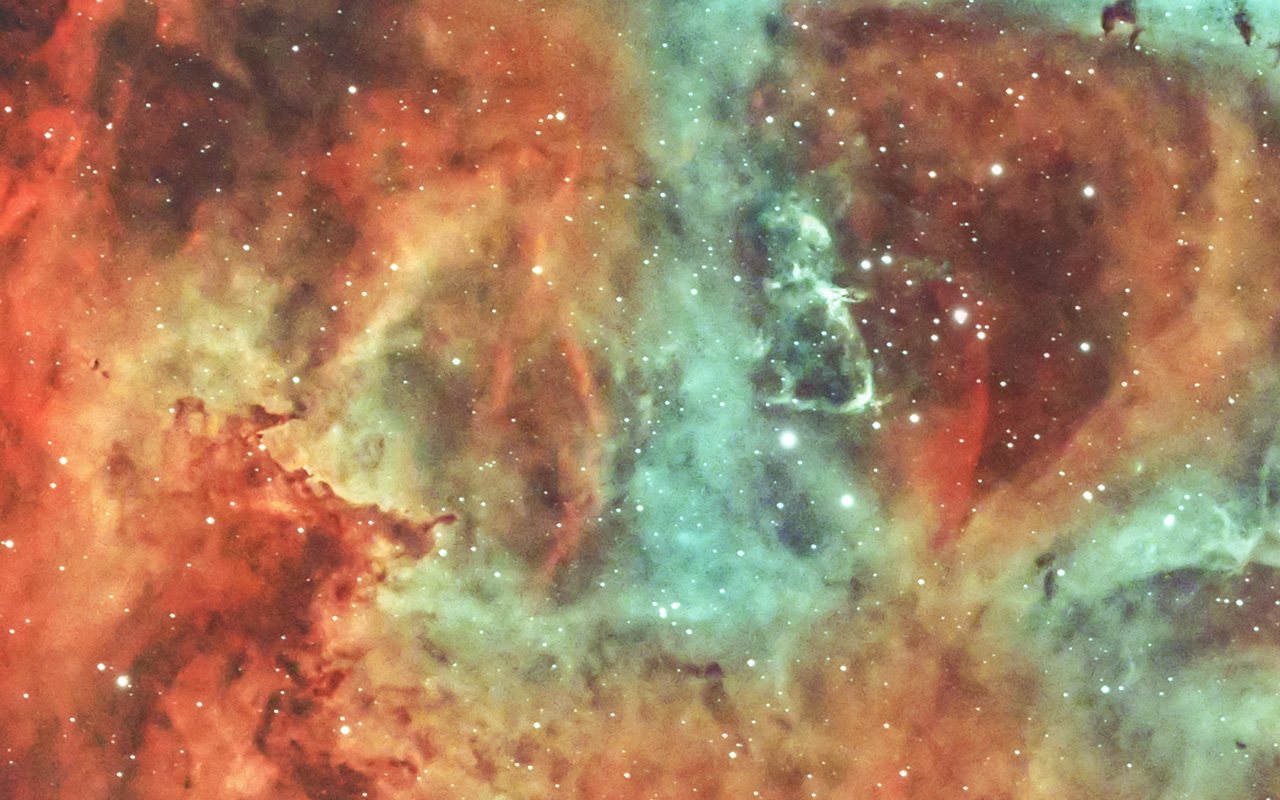
The powerful radiation and stellar winds from the young stars of NGC 2244 are carving out a huge cavity in the centre of the nebula.Two particularly massive O-type stars, HD 46223 and HD 46150, are largely responsible for creating and maintaining this enormous ionised bubble.Their intense ultraviolet radiation excites the surrounding hydrogen atoms.As those atoms release energy, the gas begins to glow — creating the magnificent emission nebula we see in astrophoto.
Star Formation
But the Rosette is not simply a beautiful glowing cloud.It is an active star-forming complex. Astronomers estimate that around 2,500 young stars are located within the region, with thousands more stars forming from the dense molecular material. Much of the ongoing star formation is concentrated in the dense molecular cloud southeast of the central bubble. Astronomers have also identified nine infrared clusters, revealing young stars that are still deeply embedded within the dust.
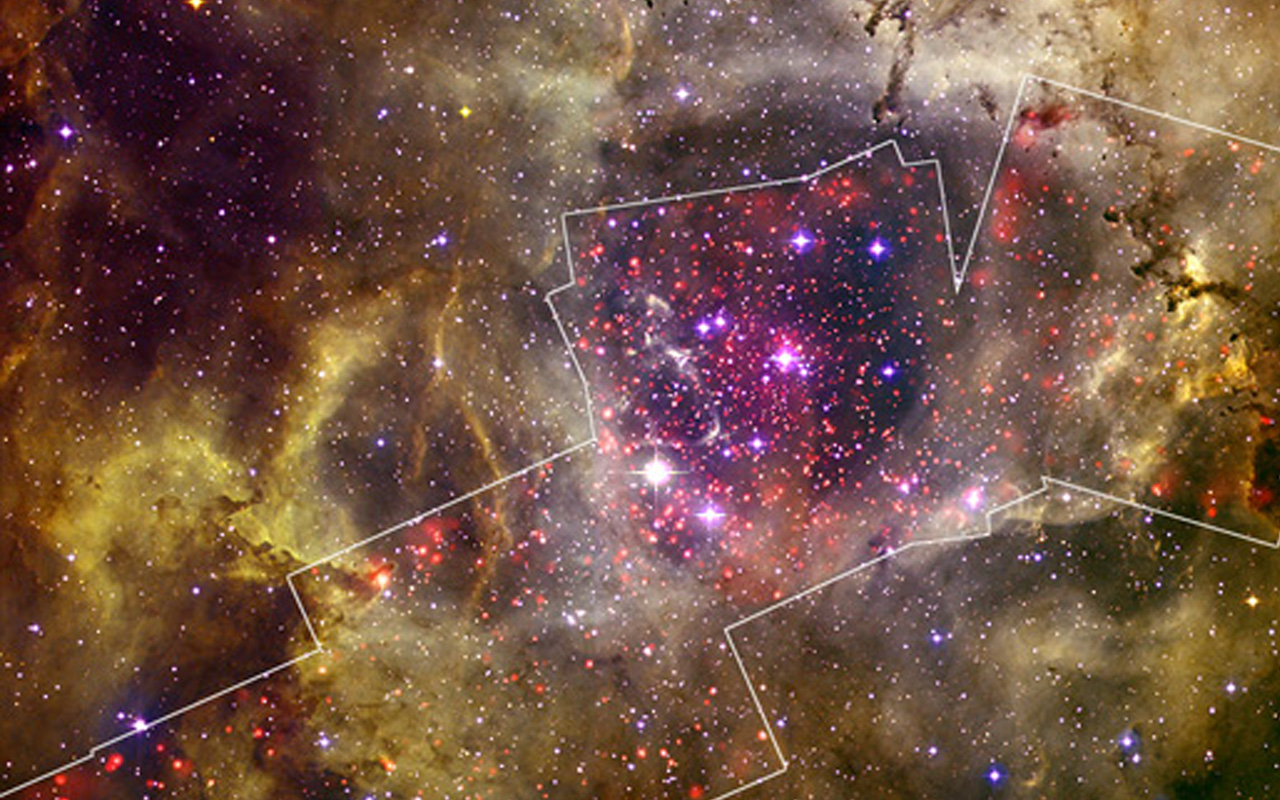
And when astronomers observe the Rosette in X-rays, another hidden layer of this stellar nursery appears.The Chandra X-ray Observatory has revealed numerous newborn stars embedded within the complex. Inside the central bubble, there is also a diffuse X-ray glow.This emission comes from super-hot plasma, with temperatures reaching approximately 1 to 10 million Kelvin. That is dramatically hotter than the roughly 10,000 Kelvin plasma normally found in H II regions. The extreme temperatures are thought to come from shock-heated stellar winds produced by the massive O-type stars.
This is what makes the Rosette such a fascinating target for astrophotography.
What appears as a simple red nebula is actually a complex environment of ionised hydrogen, young stars, molecular clouds, stellar winds and super-hot plasma.
Through long exposures, image stacking and careful processing, astrophotographers can reveal the delicate structures hidden within the nebula — from the glowing outer clouds to the dark dust lanes surrounding the central cavity.
The final image transforms faint photons from a distant stellar nursery into a detailed view of a region where stars are being born.
The Rosette Nebula is more than a beautiful cosmic flower.
It is a giant stellar nursery, containing around 10,000 solar masses of material and thousands of young stars. At its heart, powerful stars are shaping the cloud that gave birth to them. And from 5,000 light-years away, we can capture this incredible process from Earth.
A cosmic flower.
A stellar nursery.
A laboratory of star formation.
And through astrophotography, we capture its ancient light —one photon at a time.
Starhunter — Capturing the Invisible Universe.
Object Fact Sheet — The Rosette Nebula
Common Name: Rosette Nebula
Object Type: H II Region / Emission Nebula / Star-Forming Region
Cataloged: Caldwell 49 (C49), NGC 2237, NGC 2238, NGC 2239, NGC 2246
Other Names: Skull Nebula
Constellation: Monoceros
RA (Right Ascension): 06h 33m 45s
DEC (Declination): +04° 59′ 54″
Age: About 3 million years
Distance: About 5,000 light-years
Apparent Magnitude: 9.0
Angular Size: About 1.3° × 1.3°