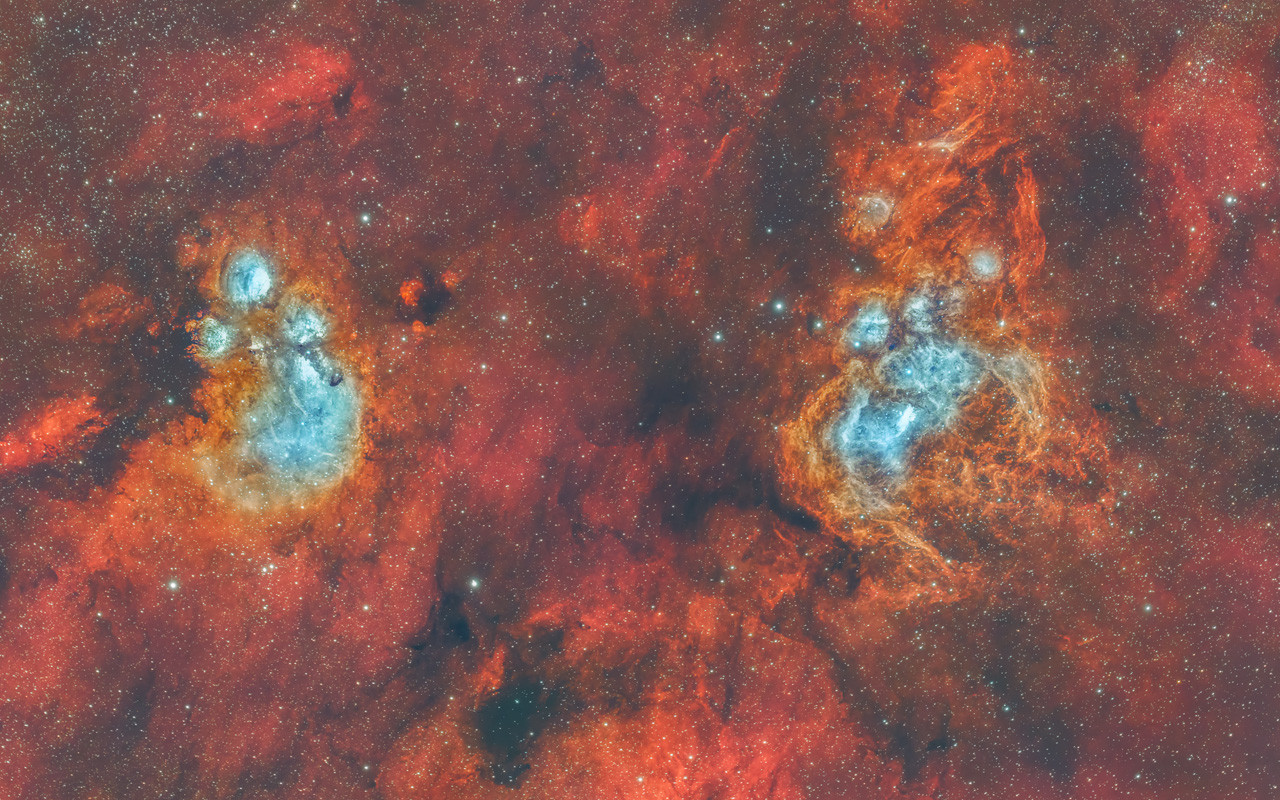
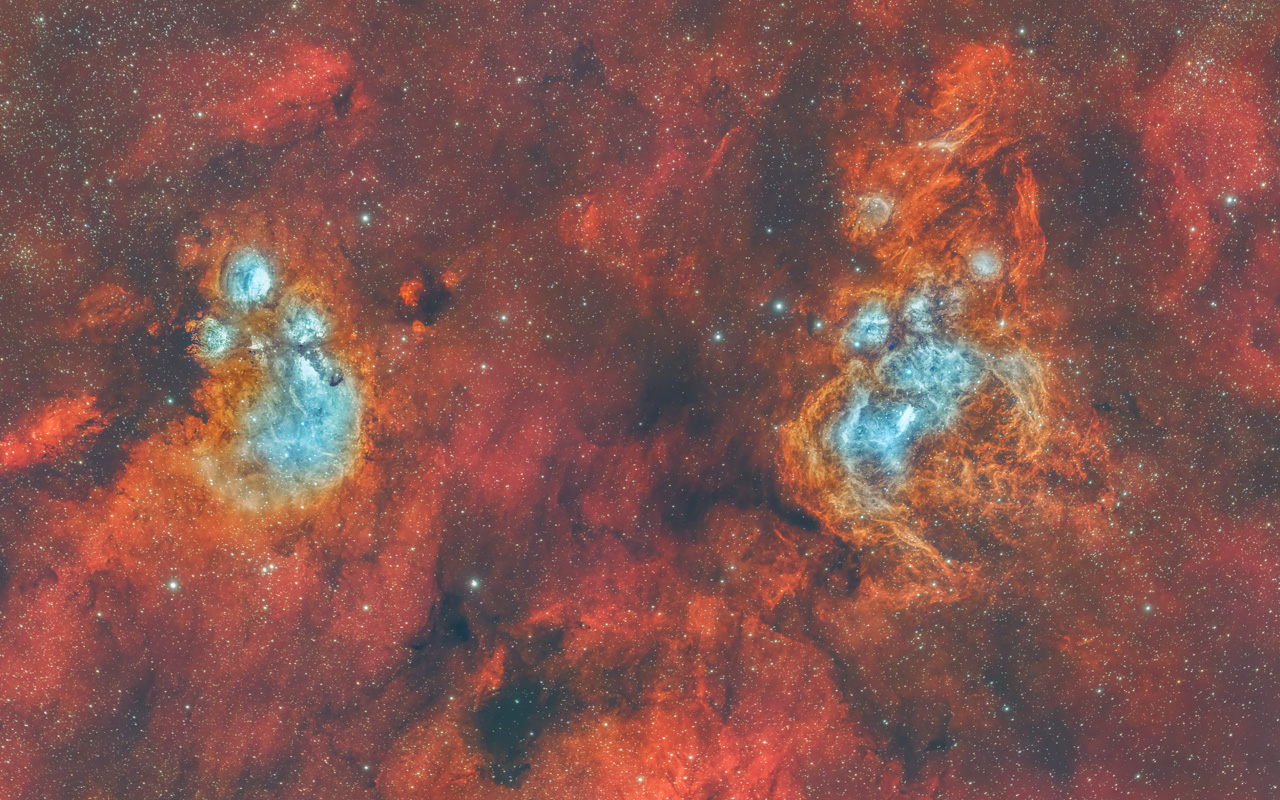
This image was captured by Joyce Leong, Starhunter Astrophotographer, under the dark skies of Mount Bromo, Indonesia. Using a William Optics RedCat 61, ZWO AM3 mount, and ZWO ASI2600MC Air, she collected a total of 4.5 hours of exposure data, revealing the faint details and intricate beauty of this celestial object.




Starhunter Astrophotographer — Joyce Leong
The Cat’s Paw and Lobster Nebulae
Object Type: Emission Nebulae / Star-Forming Regions
Look closely at this spectacular field of stars. On the upper right is the Cat’s Paw Nebula, NGC 6334.And on the lower left is the Lobster Nebula, NGC 6357.Together, they form two dramatic and closely neighbouring star-forming complexes in the constellation Scorpius, along one of the richest regions of the Milky Way.
The Cosmic Neighbourhood
Both nebulae lie along the Milky Way’s Carina–Sagittarius spiral arm, a region rich in gas, dust and young stars.The Cat’s Paw Nebula lies approximately 5,000 to 5,500 light-years from Earth, while the Lobster Nebula is farther away, at around 8,000 light-years.Despite their enormous distances, they appear close together in our sky because they lie in nearly the same direction along the Milky Way.These are not simply beautiful clouds.They are enormous stellar nurseries, where new stars are being born.
Cat’s Paw Nebula
Let’s begin with NGC 6334 — the Cat’s Paw Nebula.Its glowing, rounded cavities resemble the giant toe pads of a cat’s paw, giving this nebula its famous name.It is also known as the Bear Claw Nebula and Gum 64.NGC 6334 is an emission nebula and active star-forming region.Deep inside the cloud, hot and massive young stars release enormous amounts of ultraviolet energy. This radiation ionises the surrounding hydrogen gas, causing the nebula to glow strongly in red. But hidden behind that glowing gas is a much darker environment. Dense interstellar dust obscures much of the activity taking place inside.
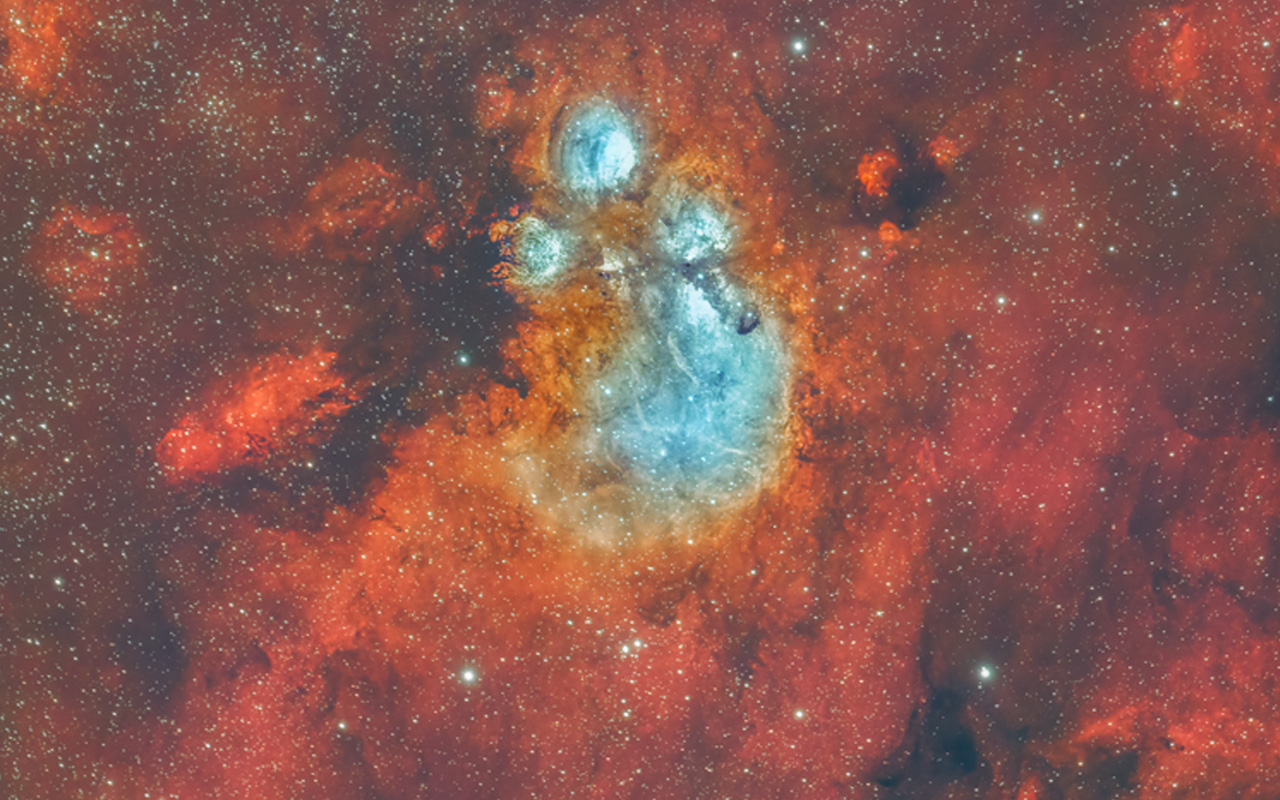
The interior of the Cat’s Paw contains enormous concentrations of material, with some dense clumps reaching up to around 3,000 times the mass of our Sun.Star formation is occurring throughout the region. Astronomers have identified several embedded star-forming sites using infrared and radio observations. At least four of these regions have developed H II regions — areas where hydrogen gas has been ionised by nearby hot, young stars.X-ray observations have also revealed around ten distinct stellar clusters, many associated with these infrared sources and H II regions. So beneath the beautiful red glow is a complex and active stellar ecosystem.
The Lobster Nebula
Now move to the lower-left portion of the image.
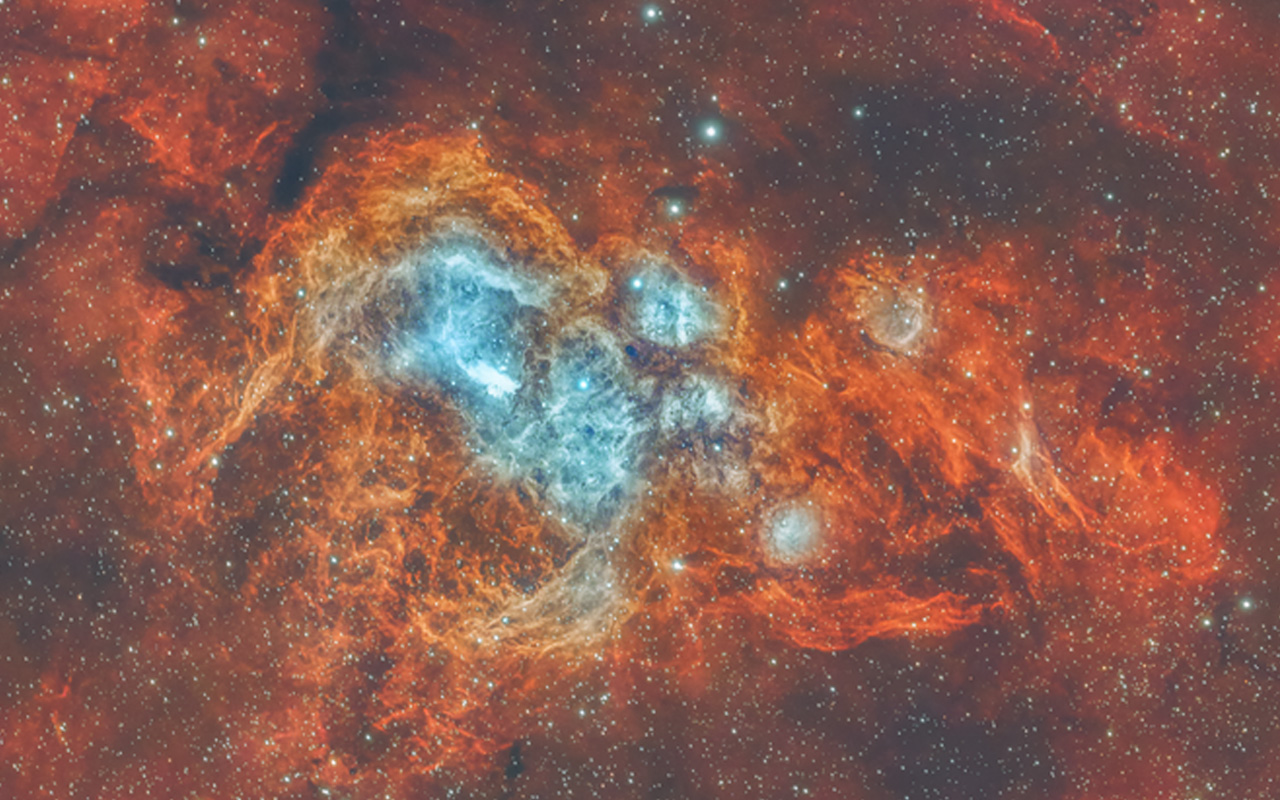
This is NGC 6357 — the Lobster Nebula, also known as the War and Peace Nebula. Its chaotic structure of glowing gas and dark dust lanes gives it the appearance of a giant cosmic crustacean.The nickname War and Peace comes from the contrasting shapes seen within the nebula — a brighter western region resembling a dove, and darker eastern structures that have been interpreted as skull-like forms. NGC 6357 is another enormous high-mass star-forming complex, with a filamentary cloud structure stretching approximately 70 light-years.
Colours and Astrophotography
The colours in this image reveal the different physical processes taking place inside these clouds.
The dominant red emission comes from ionised hydrogen, while the blue emission is associated with oxygen.Dark lanes are created by dense interstellar dust blocking the light behind them.For an astrophotographer, capturing these structures requires long exposures and careful tracking. By collecting and stacking multiple frames over five hours, faint details emerge from the darkness — revealing the glowing gas, intricate dust structures and enormous scale of these stellar nurseries.
The Cat’s Paw and Lobster Nebulae are more than beautiful objects in the Milky Way.
They are places where gas, dust and gravity are building the next generation of stars.
One lies about 5,500 light-years away.
The other, around 8,000 light-years.
And yet, from Earth, they appear together in one magnificent cosmic landscape.
Two nebulae. Two stellar nurseries. One extraordinary region of the Milky Way.
And through astrophotography, we capture their ancient light —
one photon at a time.
Starhunter — Capturing the Invisible Universe.
Object Fact Sheet — The Cat’s Paw & Lobster Nebula
Common Name: Cat’s Paw and Lobster Nebulae
Object Type: Emission Nebulae / Star-Forming Regions
Cataloged: NGC 6334 & NGC 6357
Other Names: Cat’s Paw — Bear Claw Nebula, Gum 64; Lobster — War and Peace Nebula
Constellation: Scorpius
RA (Right Ascension): 17h 20m
DEC (Declination): −35° 47′
Age: A few million years
Distance: Cat’s Paw — ~5,500 light-years; Lobster — ~8,000 light-years
Apparent Magnitude: Cat’s Paw — 5.0; Lobster — 5.0
Angular Size: Cat’s Paw — ~40′ × 30′; Lobster — ~50′ × 40