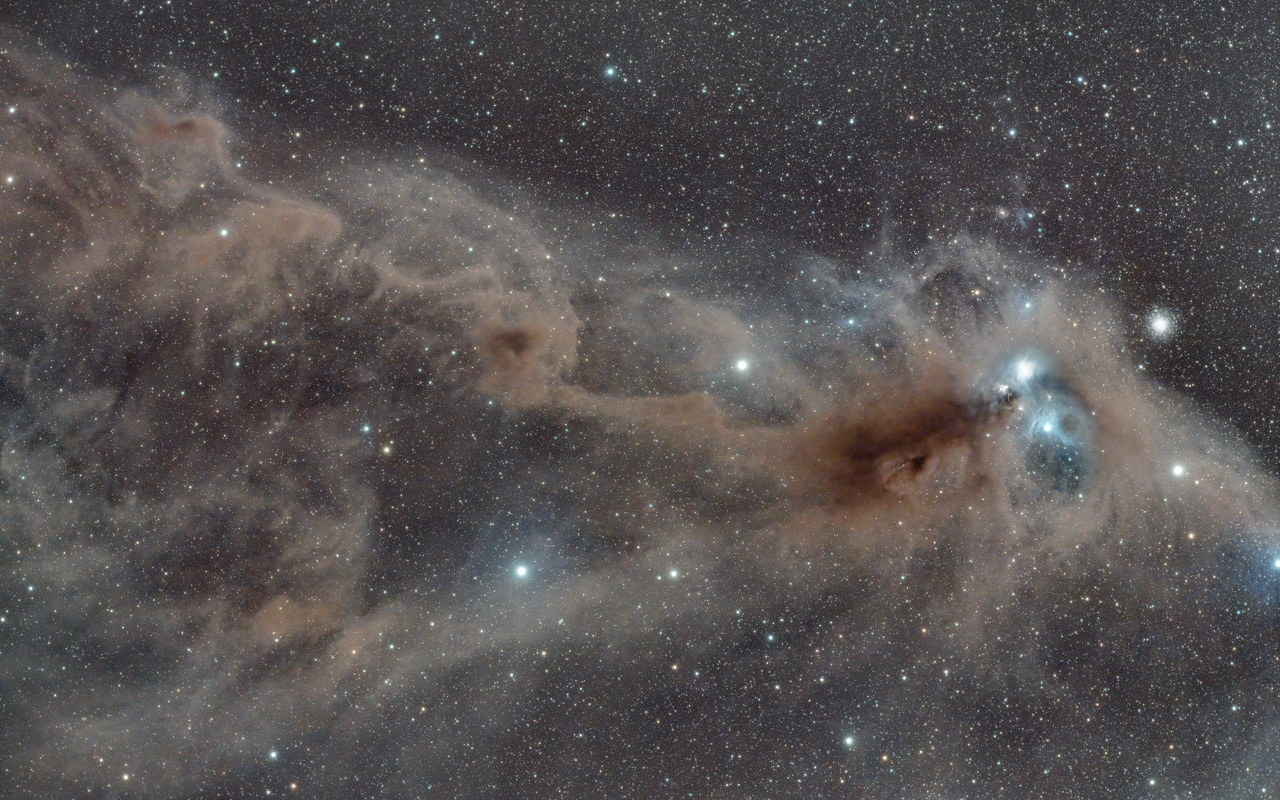
This image of the Corona Australis Molecular Cloud was photographed by Louis Ng, Starhunter Astrophotographer.Captured under the dark skies of Mount Bromo, Indonesia, the image was created using a William Optics RedCat 71, ZWO AM3 mount, and ZWO ASI2600MC Pro camera, with a total integration time of 5 hours.The final image reveals the delicate structures of interstellar dust and the faint reflection nebulae hidden within this nearby stellar nursery.




Starhunter Astrophotographer — Louis Ng
Corona Australis Molecular Cloud
Object Type: Molecular Cloud / Dark Nebula / Star-forming Region
Look closely at this image.What appears to be a beautiful field of stars is actually a vast landscape of cosmic dust and molecular gas — the Corona Australis Molecular Cloud.Located about 130 parsecs, or roughly 430 light-years from Earth, it is one of the closest known star-forming regions to our Solar System. Also known as the CrA Dark Cloud, this remarkable region contains dark molecular clouds, reflection nebulae and young stars — all captured together in this extraordinary astrophotography.
Reveal the Dark Cloud Structure
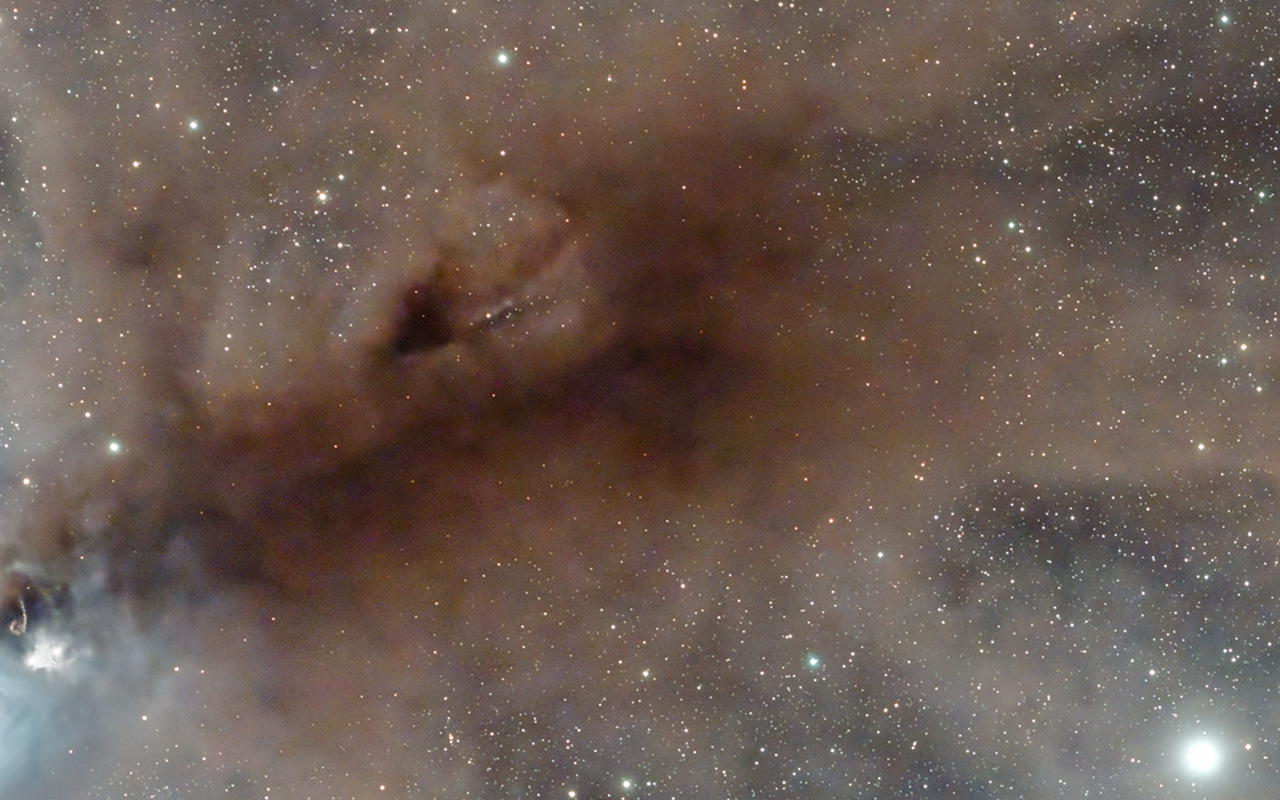
The dark structures you see across the image are not empty space.
They are dense clouds of cold gas and cosmic dust, absorbing and blocking the light from stars behind them.
The densest part of the cloud stretches for roughly 8 light-years.Temperatures within the cloud can be as low as 13 to 22 Kelvin — only a few degrees above absolute zero.
And hidden inside this cold darkness is something remarkable:
A stellar nursery. New stars are forming within these dense clouds, making Corona Australis an important laboratory for studying how stars are born.
Reflection Nebulae
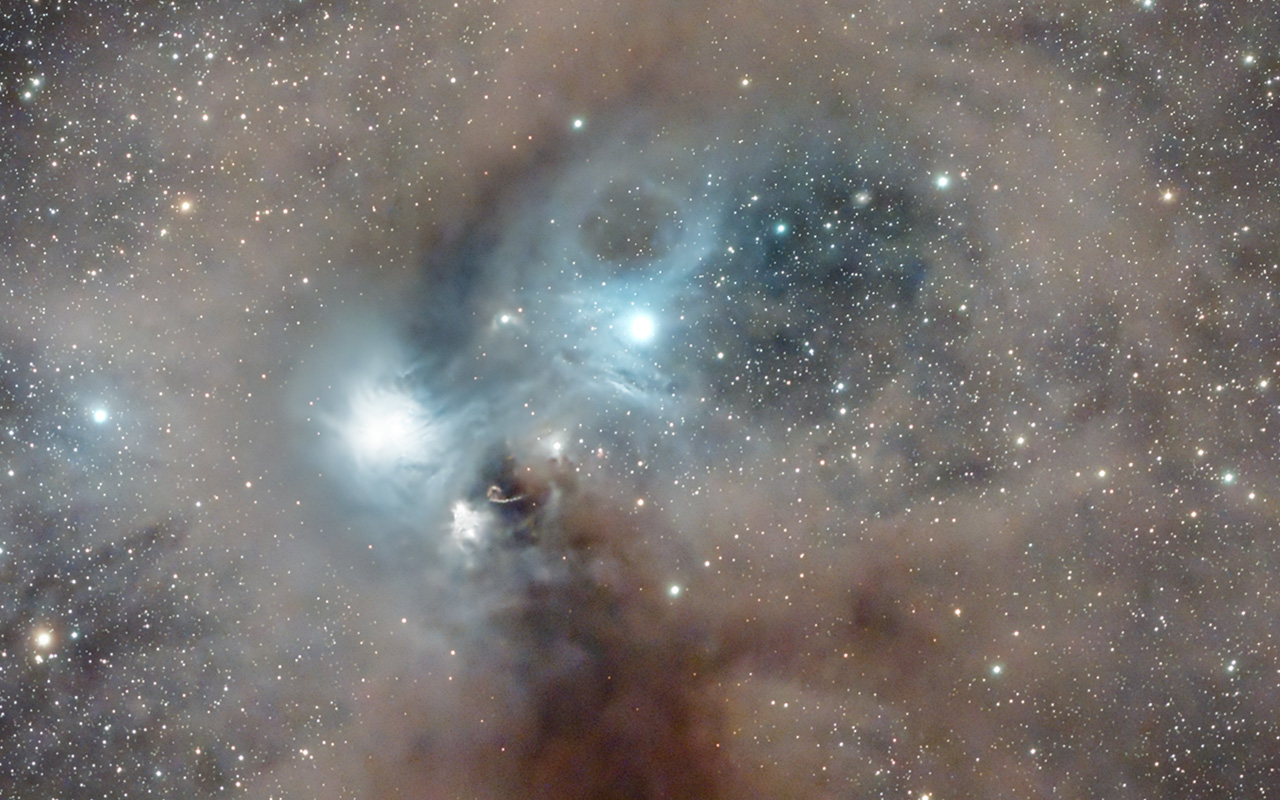
At the tip of the cloud lies one of its most beautiful regions — a group of reflection nebulae known as NGC 6726, NGC 6727, NGC 6729 and IC 4812.Their characteristic blue colour is created when light from nearby stars scatters off surrounding cosmic dust.
The dust does not simply glow on its own.Instead, it acts like a vast cosmic reflector, redirecting starlight toward us.
Among these structures is NGC 6729, surrounding the young variable star R Coronae Australis. Here, we are witnessing the interaction between young stars and the very material from which they were formed.
Cosmic Perspective
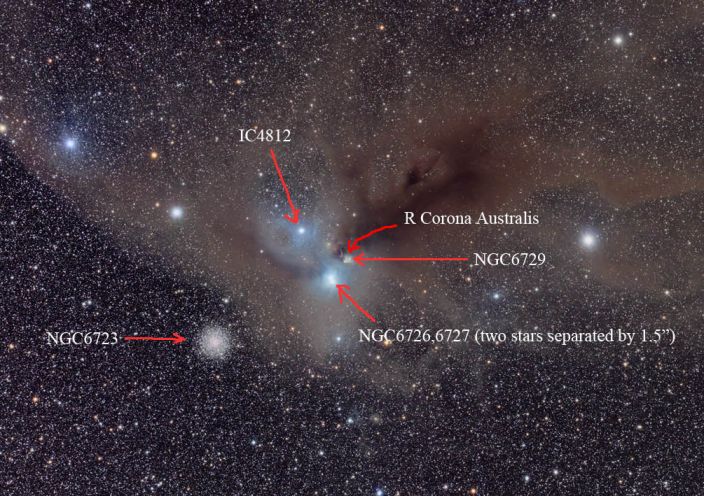
And then there is another fascinating object in this same field.
Look toward the upper-right.That magnificent globular cluster is NGC 6723.It appears to sit beside the Corona Australis Cloud — but appearances can be deceiving.NGC 6723 is actually nearly 30,000 light-years away.The molecular cloud is only about 430 light-years from us.
They are separated by an enormous distance, yet from Earth they appear close together because they happen to lie along almost the same line of sight.
A beautiful reminder that an astrophotograph can reveal not just what is in space — but also the three-dimensional structure of the universe.
Capturing a Scene Like this Requires Patience.
The molecular clouds are extremely faint, and their subtle structures can easily disappear into the background sky.By collecting photons over five hours, stacking multiple exposures and carefully processing the data, the hidden details gradually emerge.The dark dust, blue reflection nebulae and dense Milky Way star field are brought together into a single image.Every tiny detail represents photons that have travelled through space for hundreds — or even thousands — of years before reaching the camera sensor.
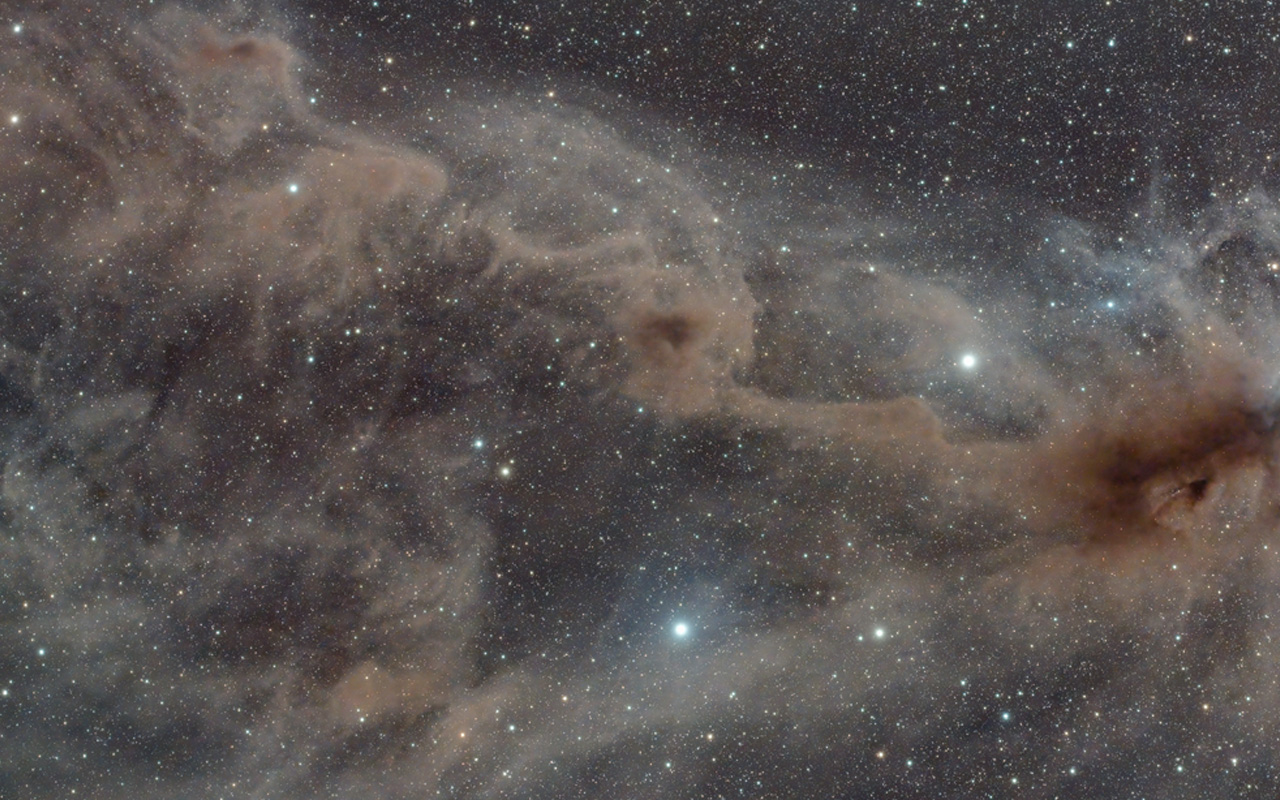
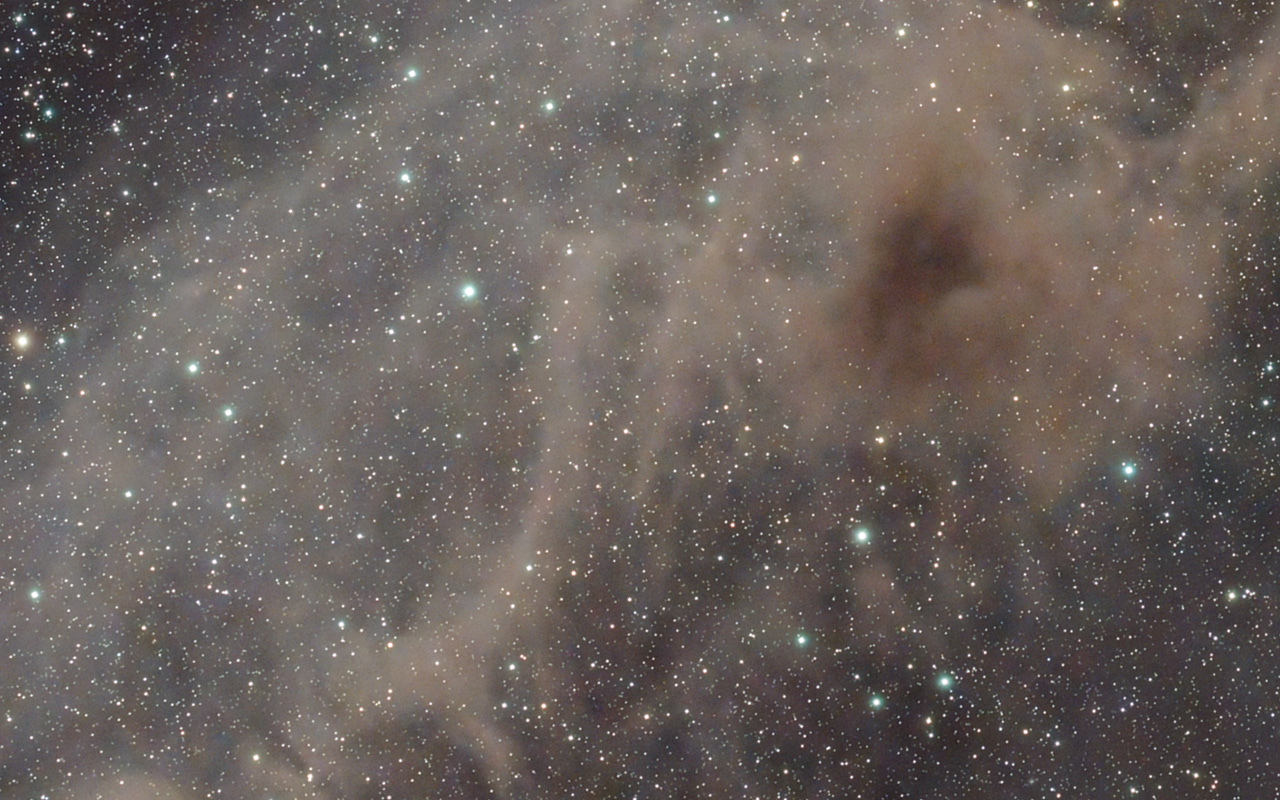
The Corona Australis Molecular Cloud reminds us that the night sky is far more than a collection of stars.
Behind the darkness are vast clouds of cold gas and dust.
Within them, new stars are being born.
And in the same frame, an ancient globular cluster lies nearly 30,000 light-years away.
This is the beauty of astrophotography.
We are not simply photographing the night sky.
We are capturing the history, structure and evolution of the universe — one photon at a time.
Starhunter — Capturing the Invisible Universe.
Object Fact Sheet — Corona Australis Molecular Cloud
Common Name: Corona Australis Molecular Cloud
Object Type: Molecular Cloud / Dark Nebula / Star-forming Region
Cataloged: CrA Dark Cloud
Other Names: Corona Australis Cloud, CrA Cloud
Constellation: Corona Australis
RA (Right Ascension): 19h 01m
DEC (Declination): −37° 00′
Age: Several million years
Distance: About 430 light-years (130 parsecs)
Apparent Magnitude: Not applicable
Angular Size: About 16° × 6.5°