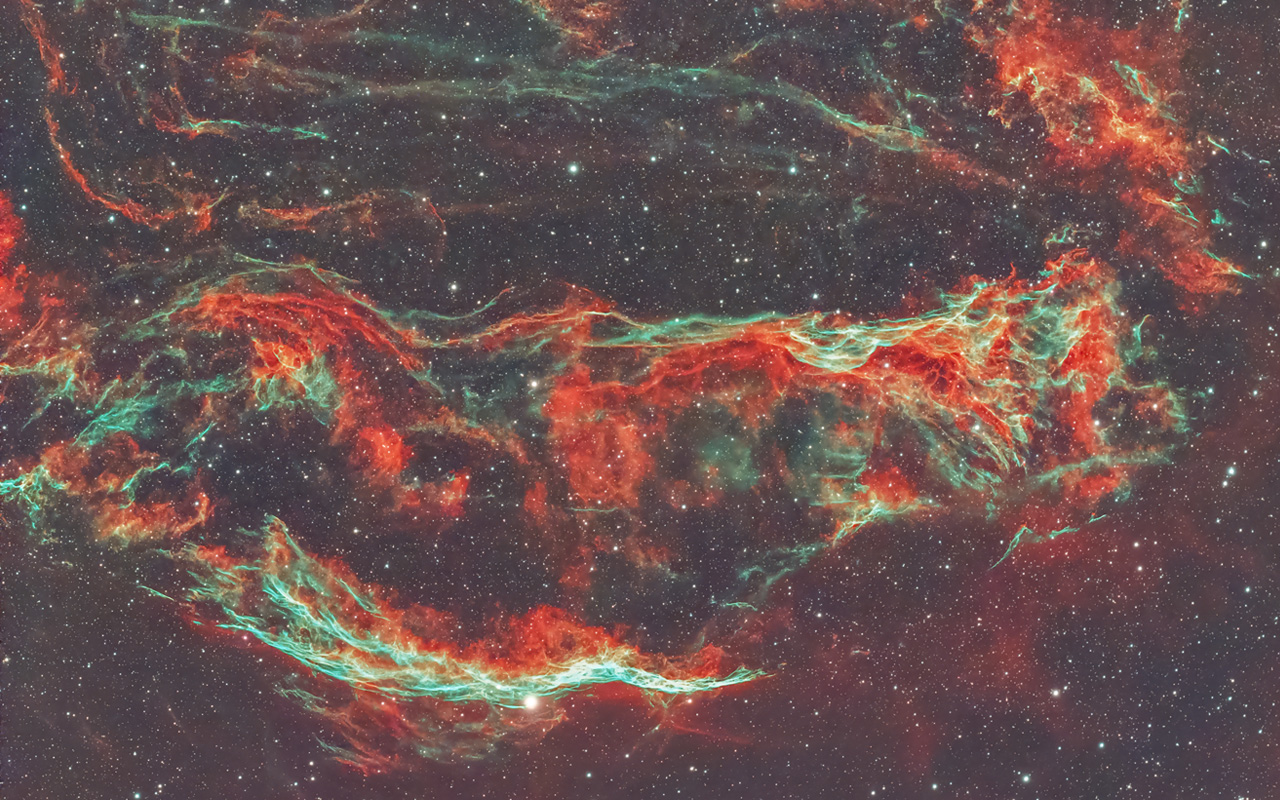
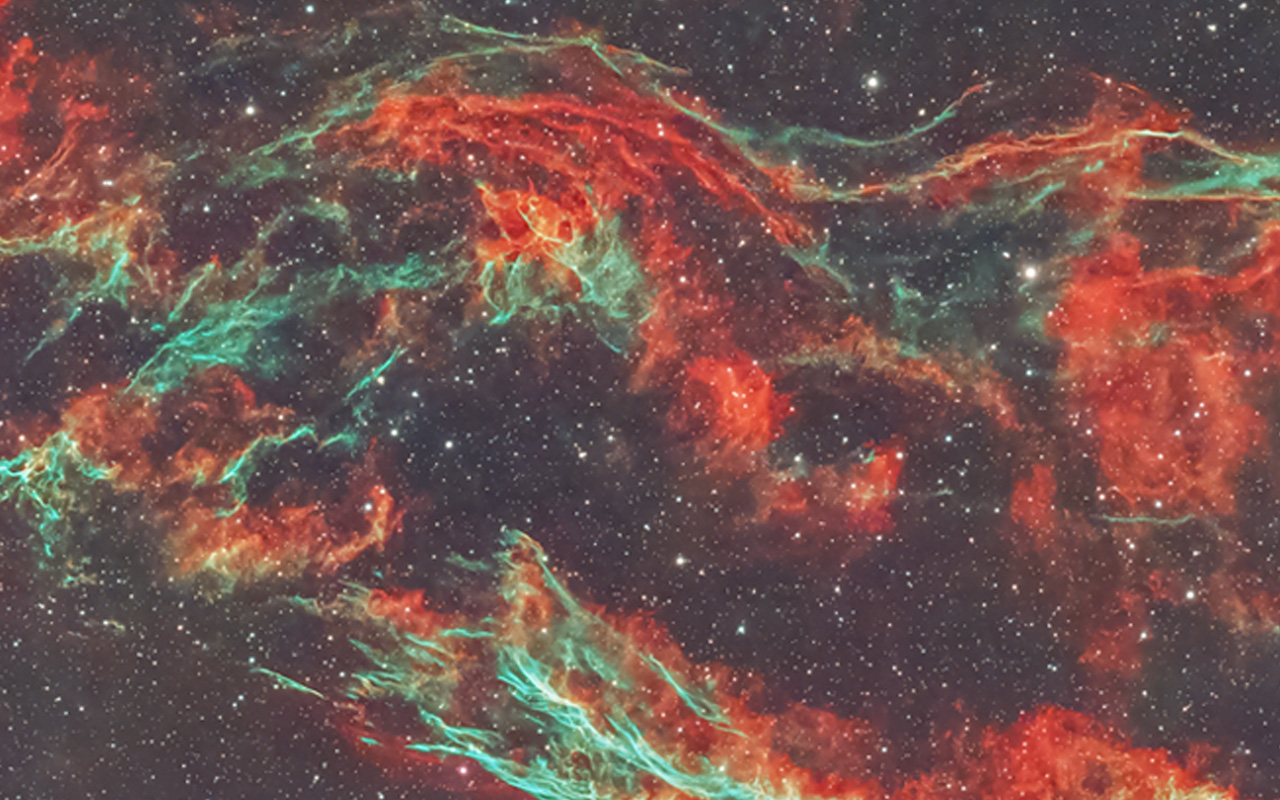
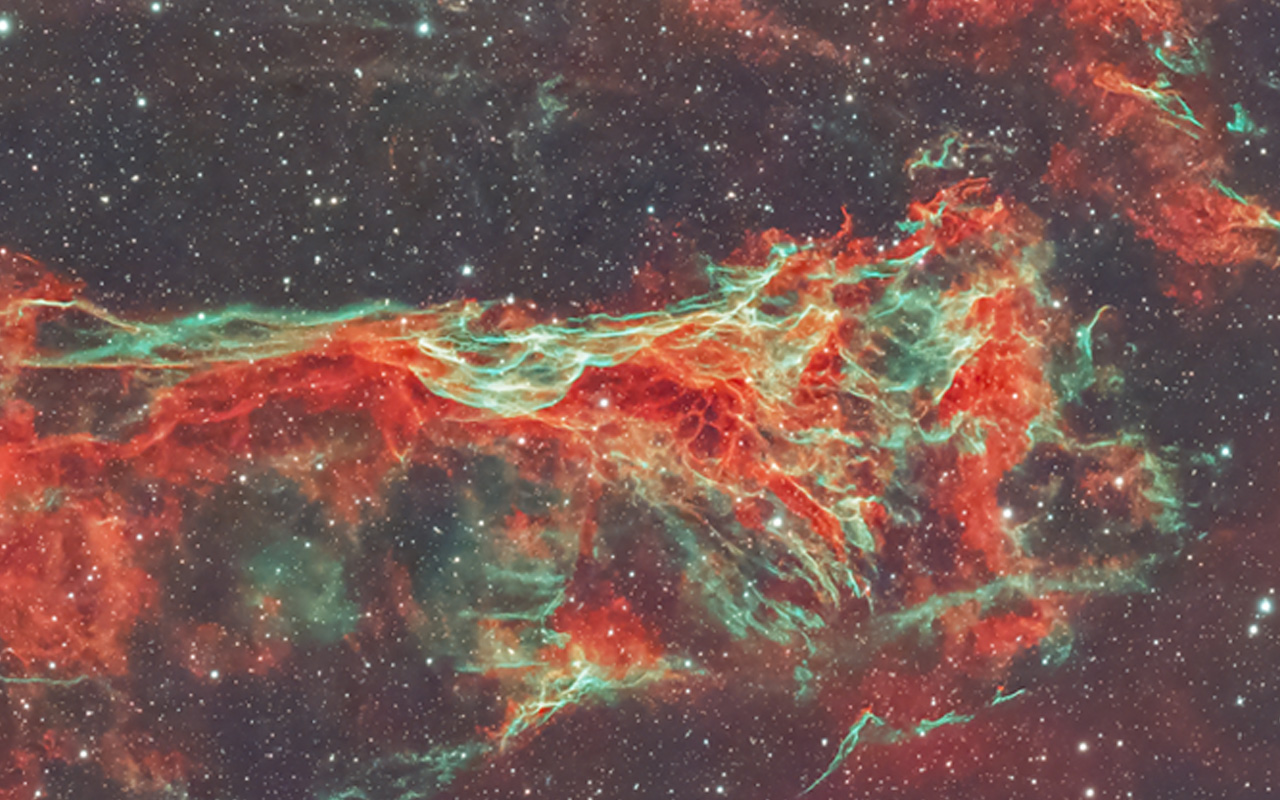
This image of the Veil Nebula Supernova Remnant was photographed by Muhammad Nur Adli bin Roslan, Starhunter Astrophotographer. Captured under the dark skies of Mount Bromo, Indonesia, the image was created using a William Optics RedCat Mini 51, ZWO AM3 mount, and ZWO ASI533MC Pro camera, with a total integration time of 2.5 hours.




Starhunter Astrophotographer — Muhammad Nur Adli bin Roslan
Veil Nebula Supernova Remnant
Object Type: Supernova Remnant
Look closely at this image.What appears to be a delicate curtain floating among the stars is actually the violent aftermath of a massive stellar explosion.This is the Veil Nebula — a vast cloud of heated and ionised gas and dust in the constellation Cygnus, the Swan.It is one of the brightest portions of the Cygnus Loop, a spectacular supernova remnant created by the death of a massive star.Its delicate, draped filamentary structures are the reason it became known as the Veil Nebula.
Scale and Location
The Veil Nebula is enormous.
The entire structure spans roughly 110 light-years and appears across an area of sky equivalent to about six full Moons.Yet this enormous structure is relatively nearby on the cosmic scale, lying approximately 2,100 light-years from Earth.From our perspective, we are looking across thousands of light-years of space toward the remains of a star that ended its life in a spectacular explosion.
The supernova — Animation of Massive Star Exploding
Around 10,000 years ago, a massive star reached the end of its life.Its progenitor star is estimated to have been around 20 times the mass of our Sun. A star this massive lives fast and dies young.When its nuclear fuel was exhausted, the star could no longer support itself against gravity.Its core collapsed, triggering a catastrophic supernova explosion.In an instant, enormous amounts of energy and material were released into space.The explosion sent a powerful shock wave racing outward, sweeping through the surrounding gas and dust.And what we see today is the slowly expanding aftermath of that ancient stellar catastrophe.
Filamentary structures
The Veil Nebula is the visible portion of this enormous Cygnus Loop.
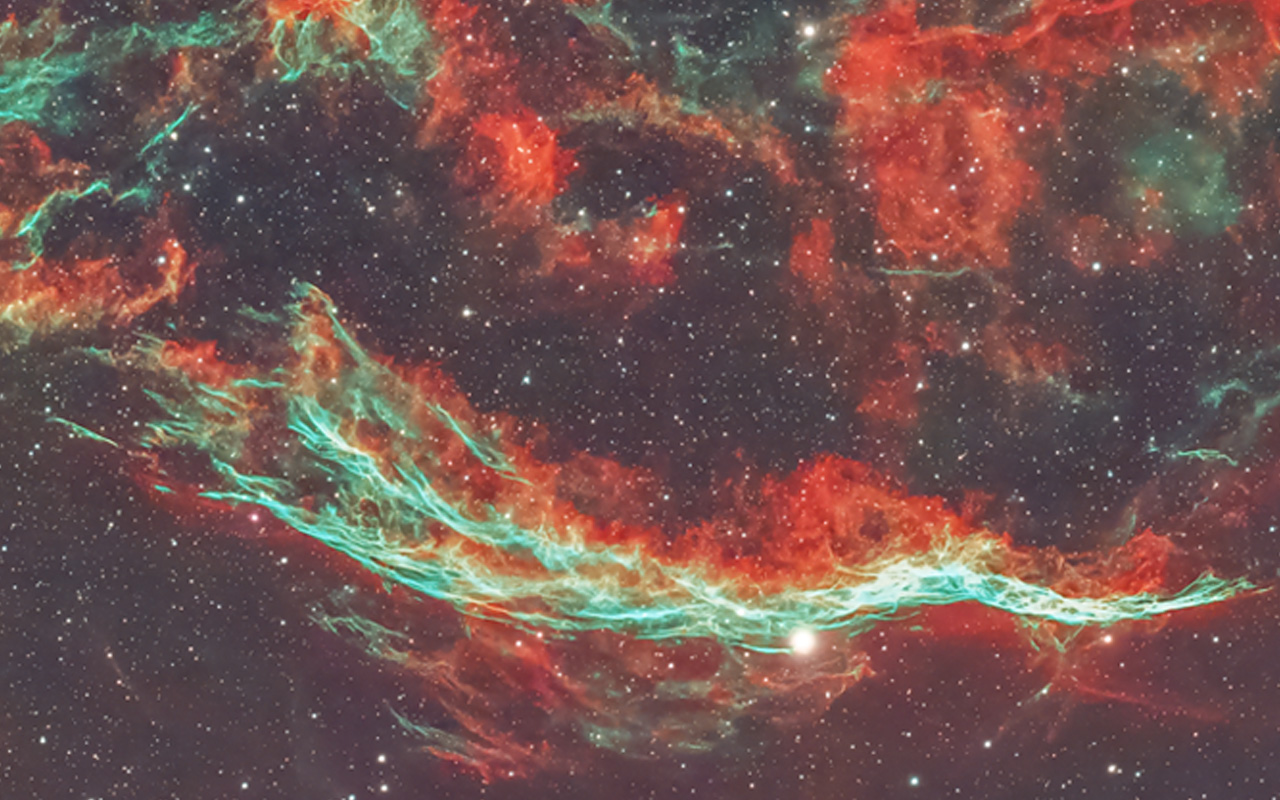
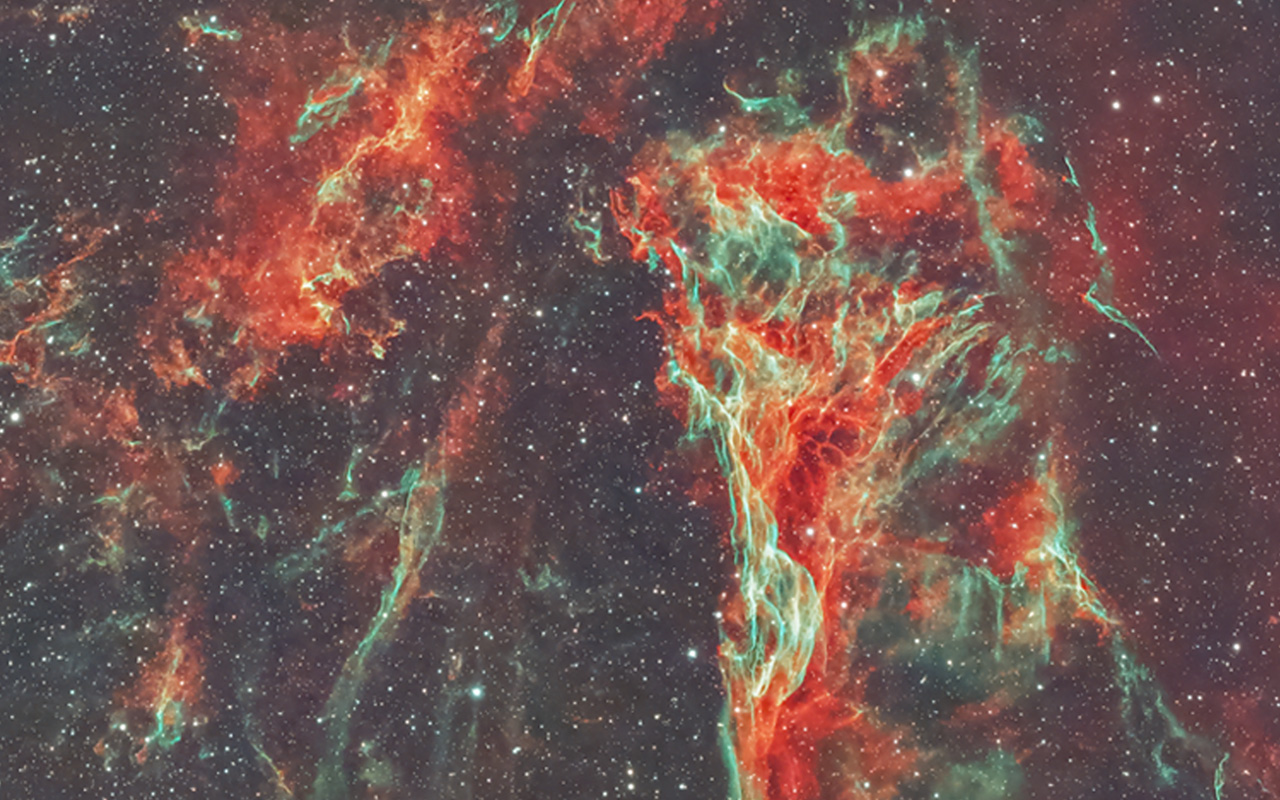
Its intricate structures were sculpted by the collision between the supernova’s blast wave and the surrounding gas and dust.The result is an extraordinary network of delicate filaments.In this image, the nebula can almost look like a crumpled bed sheet viewed from the side.The bright regions are created where the shock wave encounters relatively dense material — or where the ripples of this cosmic sheet are viewed almost edge-on.What appears delicate and peaceful is actually the result of an incredibly violent process.
Narrowband colours
The colours in this image also reveal the different elements glowing within the nebula.
Red represents hydrogen.
Green represents sulfur.
And blue represents oxygen.
The bluish structures outlining the cavity wall appear smoother and more arched compared with the fluffy green and red filaments.These differences tell us about the physical conditions and history of the gas as the supernova shock wave moves through its surroundings.The red emission comes from cooler gas that was excited by the shock collision earlier in the nebula’s evolution. Over time, this material has expanded and diffused into a more chaotic structure.
And the speed of this expanding shock wave is astonishing.Some of the thin, crisp-looking red filaments form as gas is swept into the shock wave at speeds approaching one million miles per hour.At that speed, something could travel from Earth to the Moon in only about 15 minutes.Imagine that scale of energy moving through space — and yet, thousands of years later, we can still see its effects.
The Veil Nebula is therefore more than a beautiful astrophotograph.
It is the surviving signature of a massive star that lived, exploded and transformed its surrounding environment.
A stellar death has become a cosmic work of art — expanding across 110 light-years of space.
Every filament tells part of that story.
A star died thousands of years ago.
Its light and debris continue to travel through the universe.
And today, we capture that ancient explosion — one photon at a time.
Starhunter — Capturing the Invisible Universe.
Object Fact Sheet — Veil Nebula Supernova Remnant
Common Name: Veil Nebula
Object Type: Supernova Remnant
Cataloged: NGC 6960, NGC 6974, NGC 6979, NGC 6992, NGC 6995, IC 1340
Other Names: Cygnus Loop, Caldwell 33, Caldwell 34
Constellation: Cygnus
RA (Right Ascension): 20h 45m
DEC (Declination): +30° 43′
Age: About 10,000 years
Distance: About 2,100 light-years
Apparent Magnitude: 7.0
Angular Size: About 3° × 2.5°